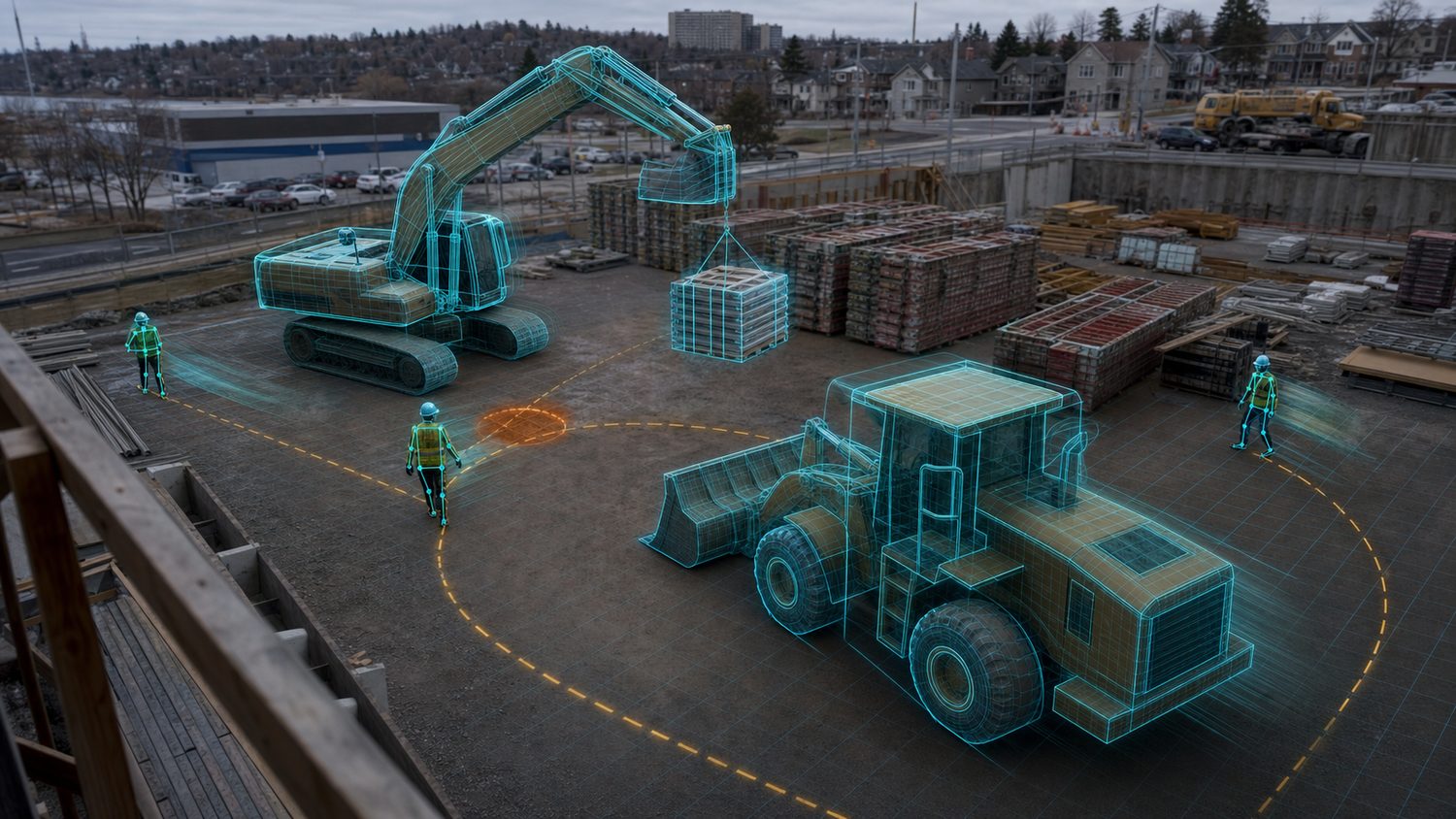
Terzonova is not a camera company, a wearable company, or a reporting tool. It is a single engineered loop that watches the whole site, forecasts hazards before they exist, intervenes faster than human perception - and converts every prevented incident into audit-grade compliance evidence.
Cloud systems cannot beat their own network: a 2–5 second round trip is built into their design, and batch uploads can take minutes. Terzonova processes every frame on a high-availability pair of ruggedized edge nodes on the site itself. The loop - RTSP ingestion under 100 ms, wireframe inference around 300 ms, rules in 20–40 ms, alert dispatch and BLE haptic delivery inside the final 60 ms - completes in under half a second, three to four times faster than a person can perceive and react. In safety, speed is not a feature. It is the difference between a near miss and a fatality report.
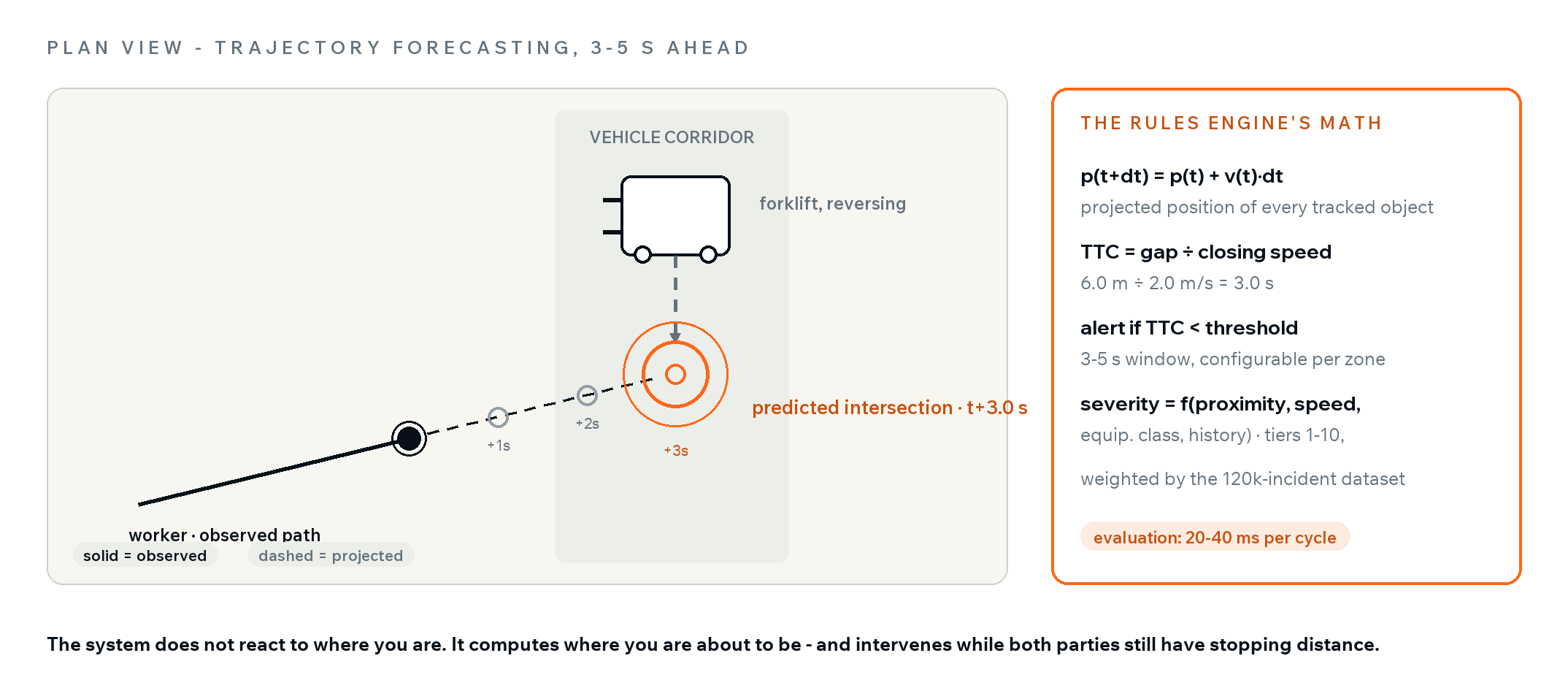
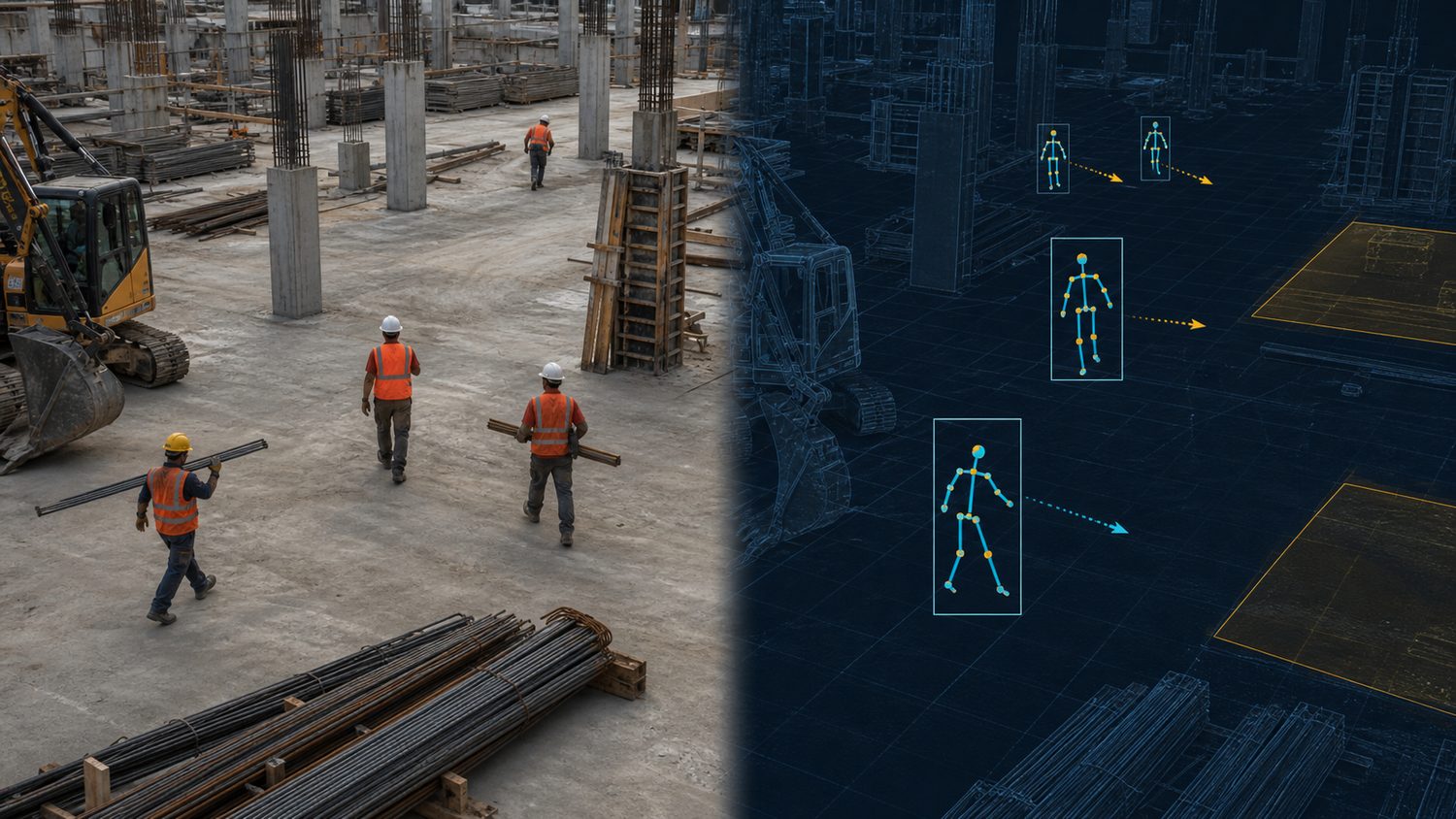
Conventional computer vision is reactive: it reports that a worker has entered a restricted zone - when the dangerous condition already exists. Terzonova assigns every tracked object a position and velocity vector in a live 3D site model refreshed up to 30 times per second, then projects every path 3–5 seconds forward and computes time-to-collision continuously.
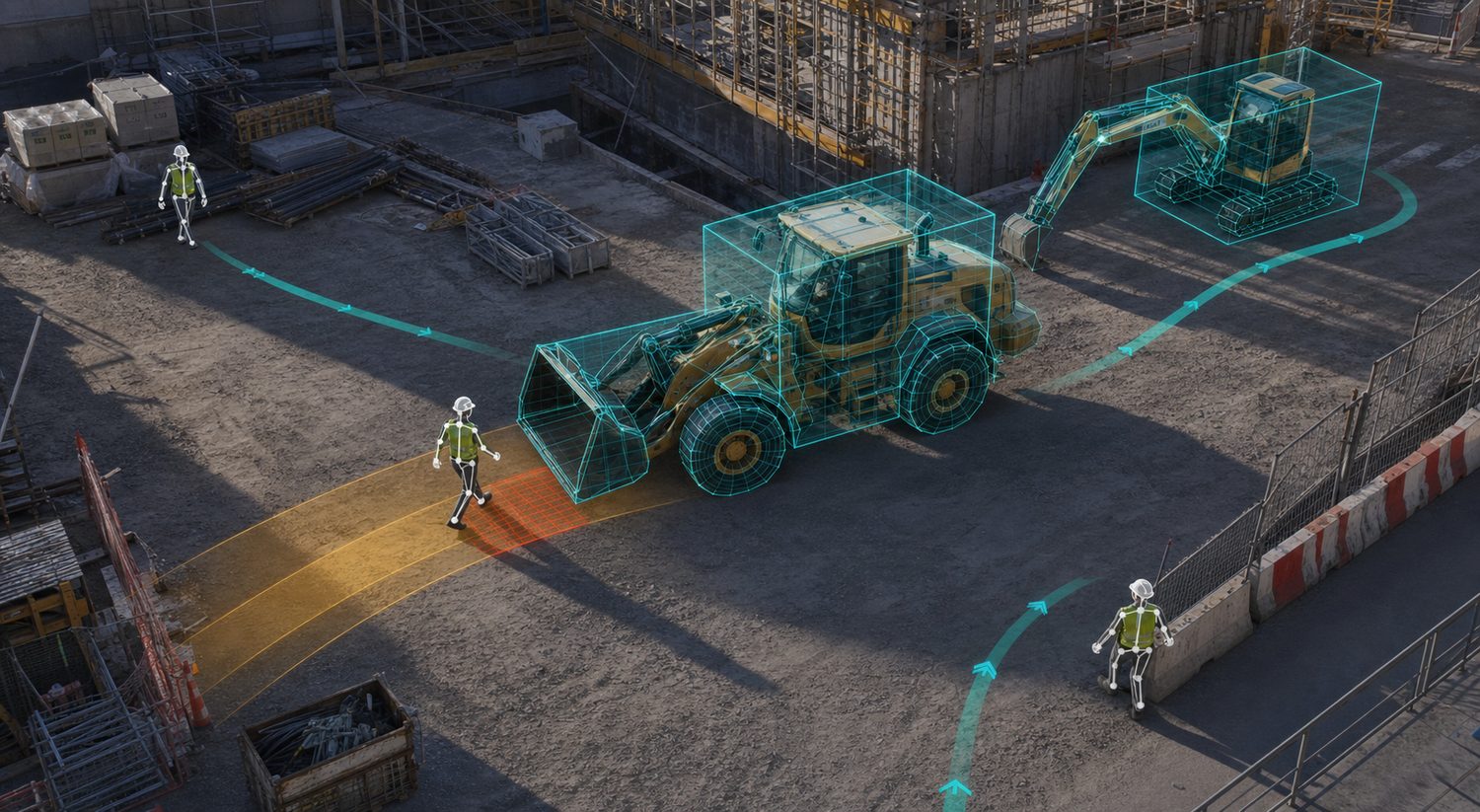
Workers (individually identified where wristbands are worn), forklifts, excavators and cranes, suspended loads, open excavations and leading edges, and configured electrical hazard zones - all simultaneously.
Proximity, closing speed, equipment class and historical incident data drive a 1–10 severity score that sets alert priority and haptic pattern - and is logged for compliance analytics.
Moving equipment projects a danger envelope that grows with speed and steering angle. A parked loader is scenery; the same loader reversing at 0.8 m/s is a moving exclusion zone the model reasons about.
Worker trust decides whether safety tech gets worn or gets left in the truck - and on unionized sites in Ontario and BC, privacy is the adoption question. Terzonova’s answer is architectural: the identifiable frame is destroyed at the edge, milliseconds after it is analyzed.
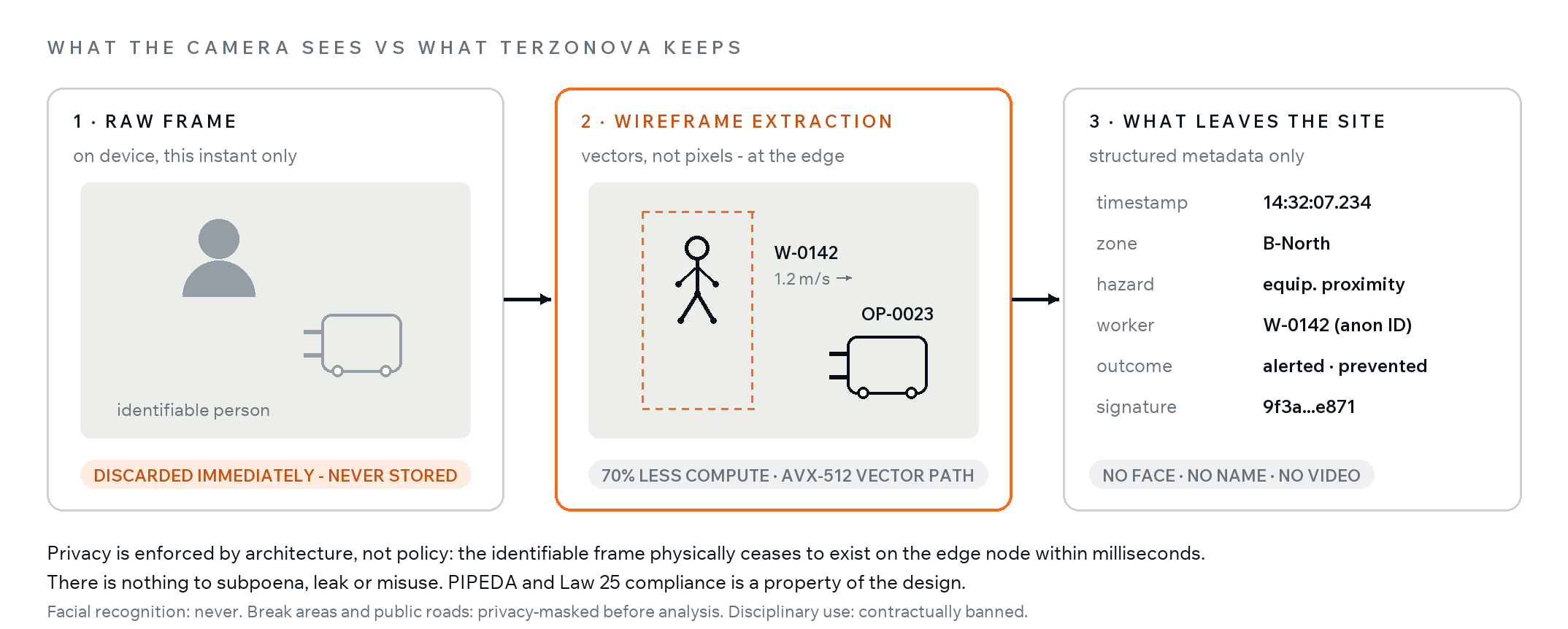
A contractual document - written to be handed directly to union representatives - that explicitly bans the use of Terzonova data for disciplinary action regarding work speed or breaks. Wristbands are alert receivers, not tracking devices: no location tracking during breaks, no productivity metrics, ever.
Break areas and public roadways are excluded by privacy masks before analysis, not filtered afterward. Granular consent management is built into onboarding, and the “no video storage” posture future-proofs deployments against tightening privacy law.
| Privacy property | Mechanism |
|---|---|
| Facial recognition | NEVER · not present in the stack |
| Raw video storage | NONE · discarded at the edge |
| Processing location | ON SITE · inside the fence line |
| Data leaving site | METADATA · + signed event clips only |
| Break-area monitoring | MASKED · excluded pre-analysis |
| Disciplinary use | BANNED · contractually, in writing |
Every alert becomes an immutable record signed at creation: millisecond timestamp, camera and zone, hazard type, anonymized worker and operator IDs, alerts delivered, outcome. The Analytical Compliance Engine maps each event to the specific provision it engages - a “worker near edge” event files under the applicable fall-protection provision of O. Reg. 213/91, instantly and legally referenced.
Inspector-ready reports generate daily and weekly. Modeled effect: a safety officer’s documentation load falls from ~15 hours a week to under 3 - an 80% reduction - while the audit trail gets stronger, because machine-signed records can’t be quietly edited after the fact.
The safety loop - camera to edge node to wristband - never touches the internet. A fibre cut, a dead LTE tower or a remote BC interior site with no coverage changes nothing: detection, prediction and alerting continue, and signed records buffer on encrypted NVMe until connectivity returns. No data lost, no protection interrupted.
This is a structural moat, not a feature toggle: cloud-dependent competitors fail exactly where Canadian construction is hardest - and where WorkSafeBC’s enforcement is strictest. The full failover design (active–active nodes, 30-minute UPS, heartbeat takeover in seconds) is on the Hardware page.
The market today is served by fragmented point solutions. Each solves one slice of the problem - and structurally cannot solve the rest.
Newmetrix, Voxel and TuMeke analyze video in the cloud - genuinely useful for post-shift auditing, posture analysis and ergonomic scoring. But a 2–5 second round trip (or batch uploads taking minutes) cannot stop a moving forklift. They report; they do not intervene.
Sensor badges like Triax Spot-r detect a fall after it happens. With no visual context, a worker jumping off a truck bed registers as an incident - the false-positive pattern that teaches crews to ignore alerts entirely.
Procore Safety and HCSS digitize checklists and incident forms - an excellent paper trail that depends on a human noticing the hazard and typing it in. Passive by design; nobody gets warned in the field.
| Capability | Terzonova | Cloud CV Newmetrix · Voxel · TuMeke |
Wearables only Triax Spot-r |
Manual software Procore · HCSS |
|---|---|---|---|---|
| Detection speed | <0.5 s · Edge AI on site | 2–5 s+ · Cloud round trip | VAR · Network dependent | N/A · Passive, reactive |
| Detection timing | BEFORE · the incident | AFTER · reactive review | AFTER · impact only | AFTER · human filing |
| Predictive analytics | 3–5 s trajectory + TTC | Image review | Accelerometer only | Static checklists |
| Worker privacy | Anonymized wireframes | Full video to cloud | RISK · Location tracking | OK · Text-only records |
| False positives | 4.2% · Target, visual context | 18–23% · Industry average | HIGH · No visual context | N/A · Human dependent |
| Compliance mapping | AUTO · Province-specific | LTD · Generic tagging | None | MANUAL · 15+ h/week input |
| Data captured | BOTH · Injuries + prevented incidents | PART · Observed events | PART · Impacts only | INJURIES · Lagging only |
| Offline resilience | FULL · Autonomous edge | Fails without internet | PART · Local buffering | Forms only |
Embedded OEM telematics (e.g. cameras on new Caterpillar machines) protect one machine at a time. Terzonova holds the whole-site model - every worker, every machine, every zone, in one coordinate frame.
Fewer recordable incidents, ~80% less reporting labour, documented due diligence against $2M-per-count exposure, and a safety record that wins competitive bids. Validated claims performance can support premium discussions with WSIB and WorkSafeBC over time.
Real-time transparency instead of sanitized monthly reports. Cryptographically signed logs that streamline liability defense, keep projects off the front page, and keep schedules clear of stop-work orders. Mandatable in tender documents.
An instant wrist-buzz about hazards they cannot see or hear. No tracking during breaks, no identity stored, minimal false alarms (4.2% target), and a contractual ban on disciplinary use. Bilingual alerts for multilingual crews.
The proprietary Safety Score: quantified, real-time risk metrics with provincial-specific assessment targeting 90% accuracy - the leading-indicator layer that lets carriers price on how a site actually behaves and reward genuine prevention.
Premium outcomes depend on each province’s workers’ compensation rules, validated claims performance and insurer approval. Terzonova provides the data; it does not set or guarantee premium levels.
Whether you are a contractor exploring a pilot, an owner setting safety standards, a broker looking for risk-engineering data, or an investor who wants to learn more - our team is ready to assist.