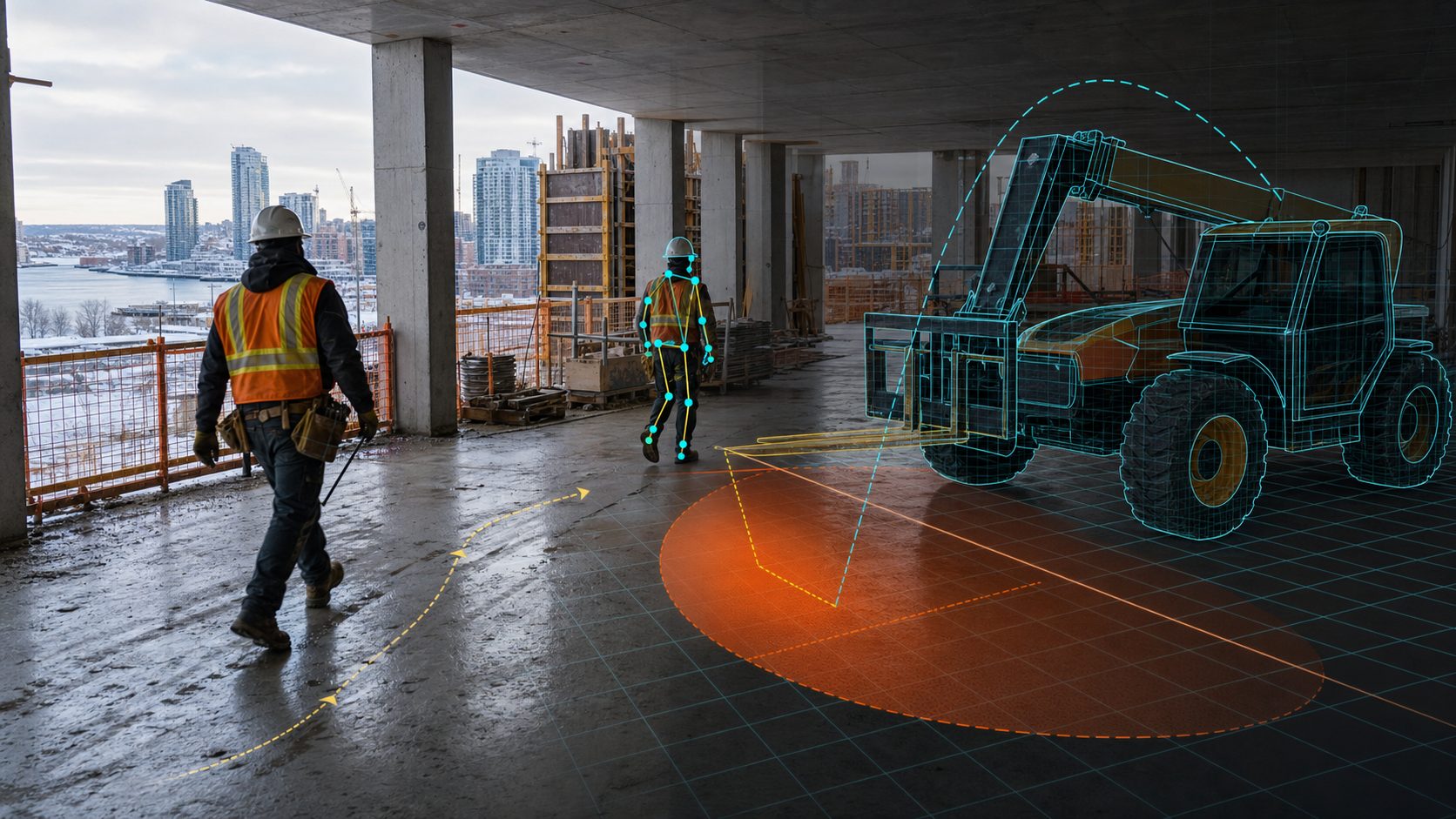
One stream of camera and sensor data. Two simultaneous outputs: real-time alarms that prevent accidents, and compliance analytics that prove how many incidents never happened. This page is the complete mechanism - every stage, every latency allocation, and two hazard scenarios traced end to end.
Human reaction time to an unexpected event averages 1.5 to 2 seconds. Cloud-based systems add another 2 to 5 seconds of round trip. Terzonova’s pipeline is engineered to deliver an alert before a person could even perceive the threat - and every stage below has a latency allocation the architecture exists to defend.
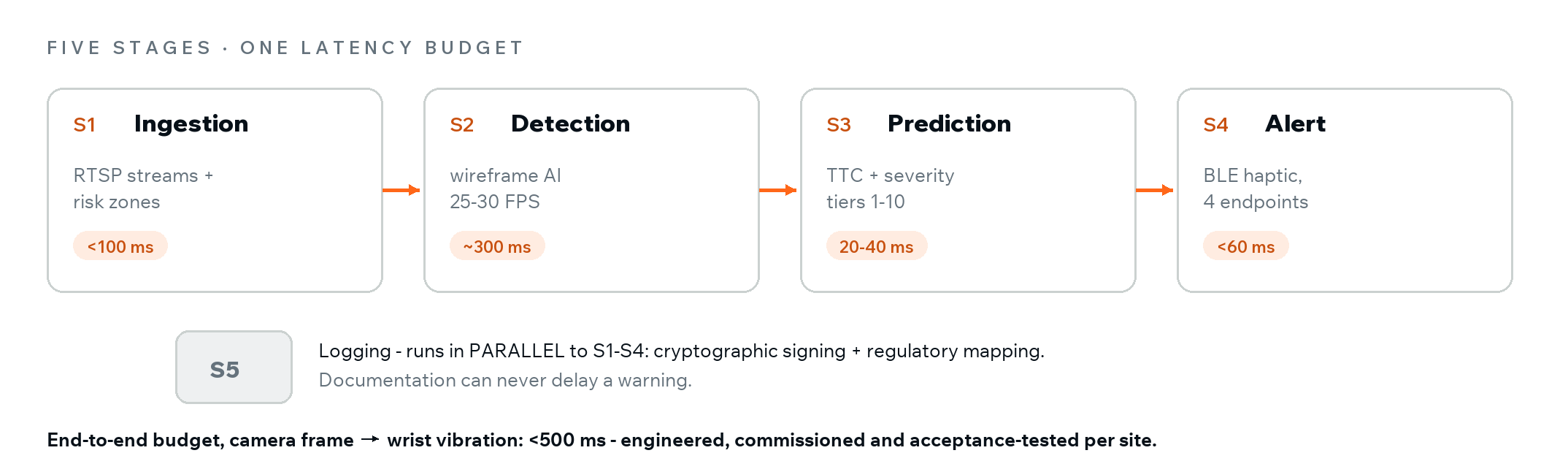
High-definition IP cameras stream video over RTSP - the open protocol most modern cameras already speak - to the on-site edge node pair. Because the system is hardware-agnostic, Terzonova layers intelligence on a site’s existing camera infrastructure; we add IP66 cameras only to close coverage gaps in travel corridors, loading zones and equipment interfaces.
Safety specialists draw digital risk zones in the dashboard - leading edges, crane paths, vehicle routes, exclusion areas - and privacy masks over break areas and public roadways, which are excluded before analysis ever happens. Workers wear BLE wristbands and carry the mobile app; both are addressable alert endpoints tied to a worker ID.
The ingestion module also negotiates stream parameters - resolution, bitrate, i-frame intervals - with camera firmware, and normalizes frames against the Canadian lighting catalogue: snow glare, dawn, dusk, dust.
The edge node runs AI inference at 25–30 frames per second using our proprietary wireframe detection method. Instead of analyzing full-resolution pixel data, the model extracts vector-based skeletal representations of people and equipment - exploiting AVX-512 vector acceleration on industrial x86 to cut computational load by roughly 70%. That is what makes real-time performance possible with no GPU cluster and no cloud bill.
Hazard-taxonomy classifiers - trained on our proprietary dataset of 120,000 verified construction incidents - track workers, mobile equipment, suspended loads, open excavations, leading edges and electrical hazard zones simultaneously. Each object carries a position and velocity vector in a live 3D site model refreshing up to 30 times per second.
Design targets: a 4.2% false-positive rate against an 18–23% industry average, and 95% PPE-detection accuracy.
The rules engine projects every tracked object 3–5 seconds forward and computes time-to-collision for every converging pair - the full math and plan-view geometry are on the Solution page. When TTC falls below the configured threshold, the event is classified into a severity tier from 1 to 10 - weighted by proximity, approach speed, equipment type and historical incident data - and the alert sequence begins while both parties still have stopping distance.
Context is everything: a worker standing still is safe; the same worker behind a reversing bulldozer is a critical threat. Temporal smoothing suppresses transient glitches so alerts fire only on genuine risk - the discipline behind the 4.2% false-positive target and the worker trust it protects.
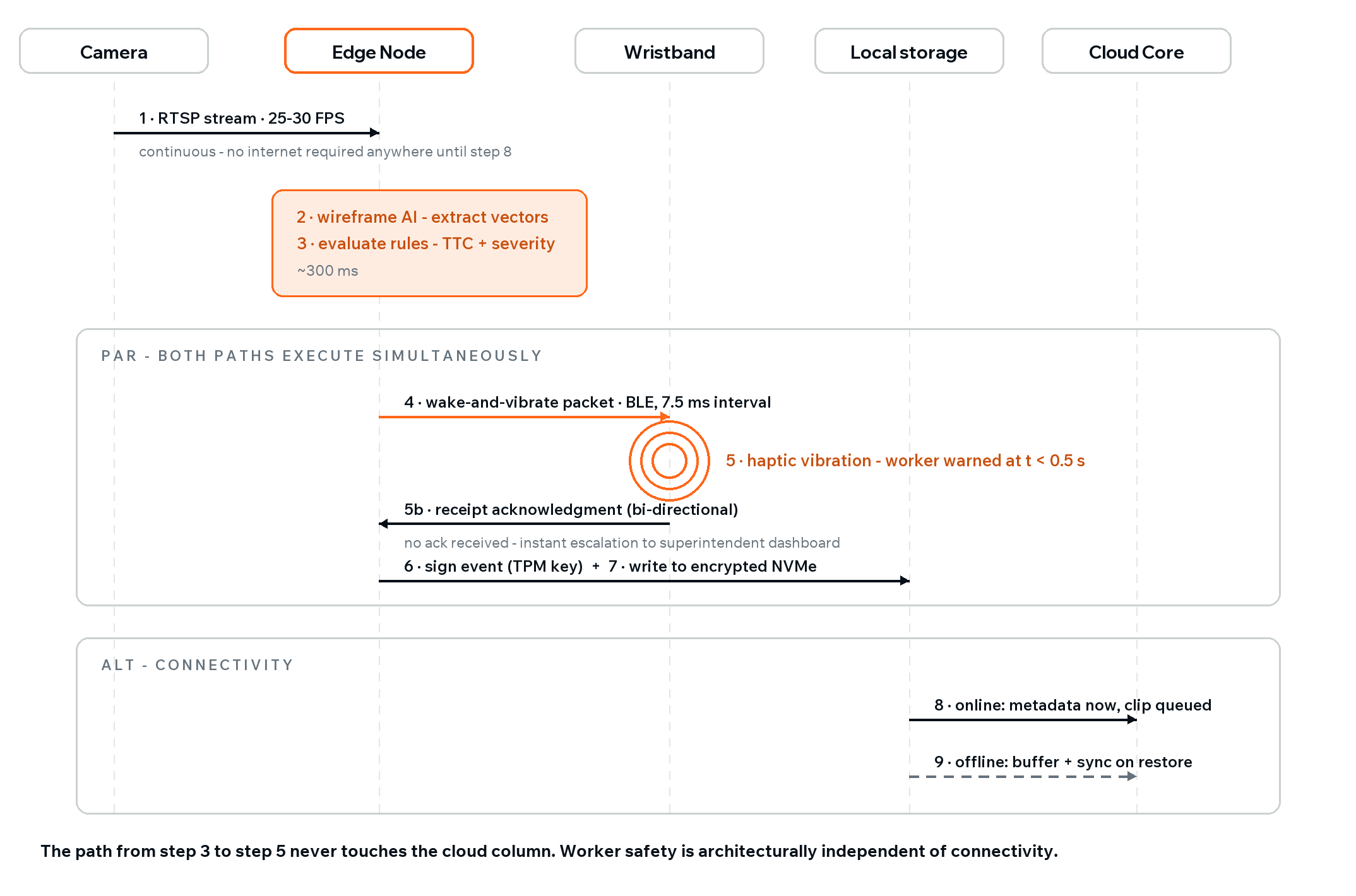
A confirmed hazard triggers a synchronized, multi-point intervention: a “wake-and-vibrate” packet to the specific wristband of the worker in danger, a visual/audio push to their phone, a proximity warning on the equipment operator’s display, and a signed entry in the event log - all in parallel. Because every wristband is already connected on a 7.5 ms BLE interval, dispatch and haptic delivery complete inside 60 ms - closing the four-stage budget under 500 ms. The full dispatch-and-escalation flow, including what happens when a worker fails to acknowledge, is diagrammed on the Hardware page.
Every alert generates an immutable, cryptographically signed record. This is Terzonova’s second decisive advantage: where TRIR-based reporting counts injuries that already happened, Terzonova logs every instance where an accident was prevented - an accident-prevention log rather than an accident log.
| Sample signed event record | |
|---|---|
| Timestamp | 2026-03-15 14:32:07.234 (NTP-synchronized) |
| Camera and location | CAM-07 · Zone B North |
| Hazard type | Mobile equipment proximity |
| Worker ID | W-0142 (anonymized) |
| Operator ID | OP-0023 (Forklift 3) |
| Alerts sent | Wristband · smartphone · operator display |
| Outcome | NEAR MISS PREVENTED |
| Signature | generated at the edge, TPM-held key |
The compliance engine maps each record to the applicable provision across 147 Ontario OHSA-related duties, regulatory provisions and internal safety-control requirements - with WorkSafeBC and CNESST modules in development - and aggregates counts and trends by rule, site and period into inspector-ready documentation.
This sequence diagram is the platform’s core engineering principle made visible: immediate safety must be fast and local; long-term compliance must be secure and centralized. The par block is where they split - and the alt block is why an internet outage costs nothing.
Two edge nodes split the camera load (~52 streams each) and exchange a constant heartbeat. If one fails from damage or a power surge, the survivor absorbs its streams within seconds. A 30-minute UPS rides through generator transfers; a total blackout triggers a graceful shutdown that prevents data corruption.
EdgeOS requires no internet handshake to process video or dispatch alerts. If the uplink dies, the safety loop continues untouched; signed records cache on encrypted NVMe and synchronize automatically on restore. No record is ever lost.
Events are cryptographically signed at creation - before any transmission - with keys held in the TPM. Nobody, including a site manager, can silently delete or alter history. The audit trail is immutable and legally defensible.
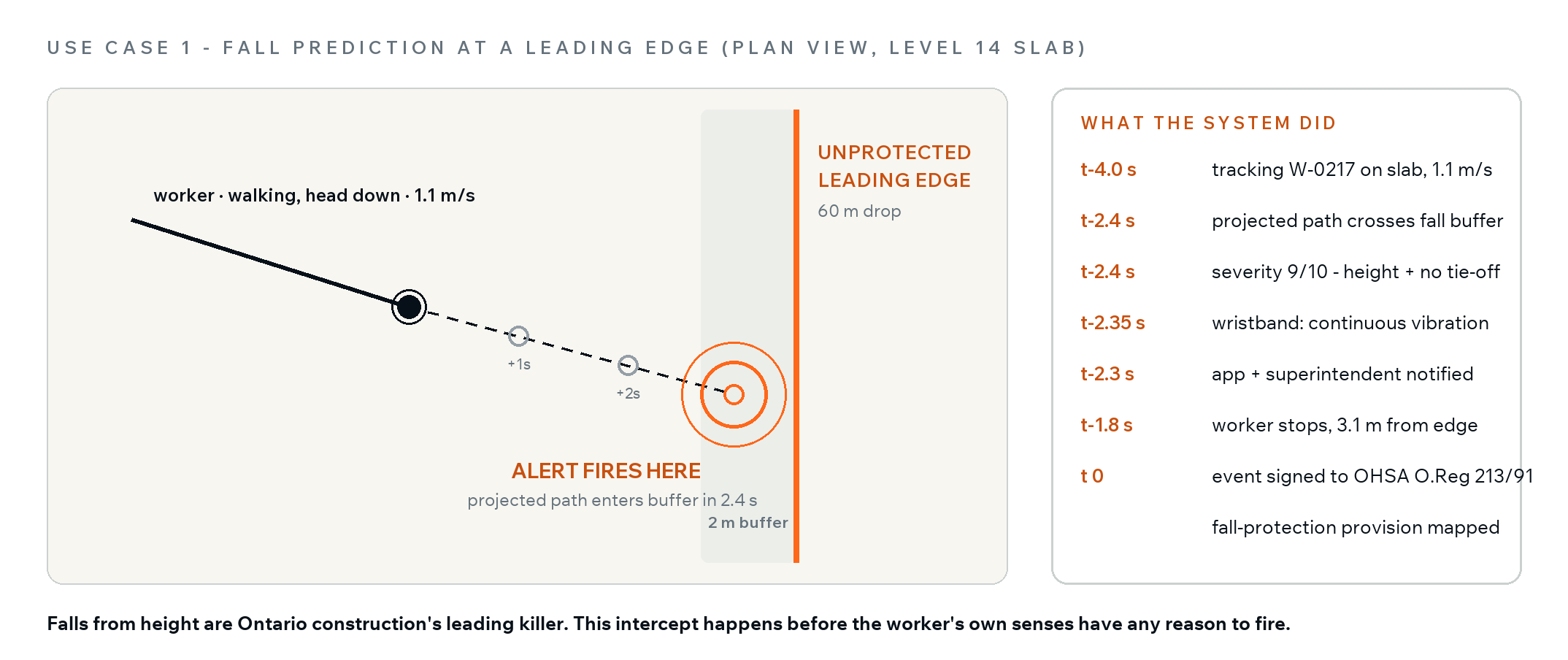
The two leading killers in Canadian construction - falls from height and struck-by incidents - traced through the pipeline event by event.
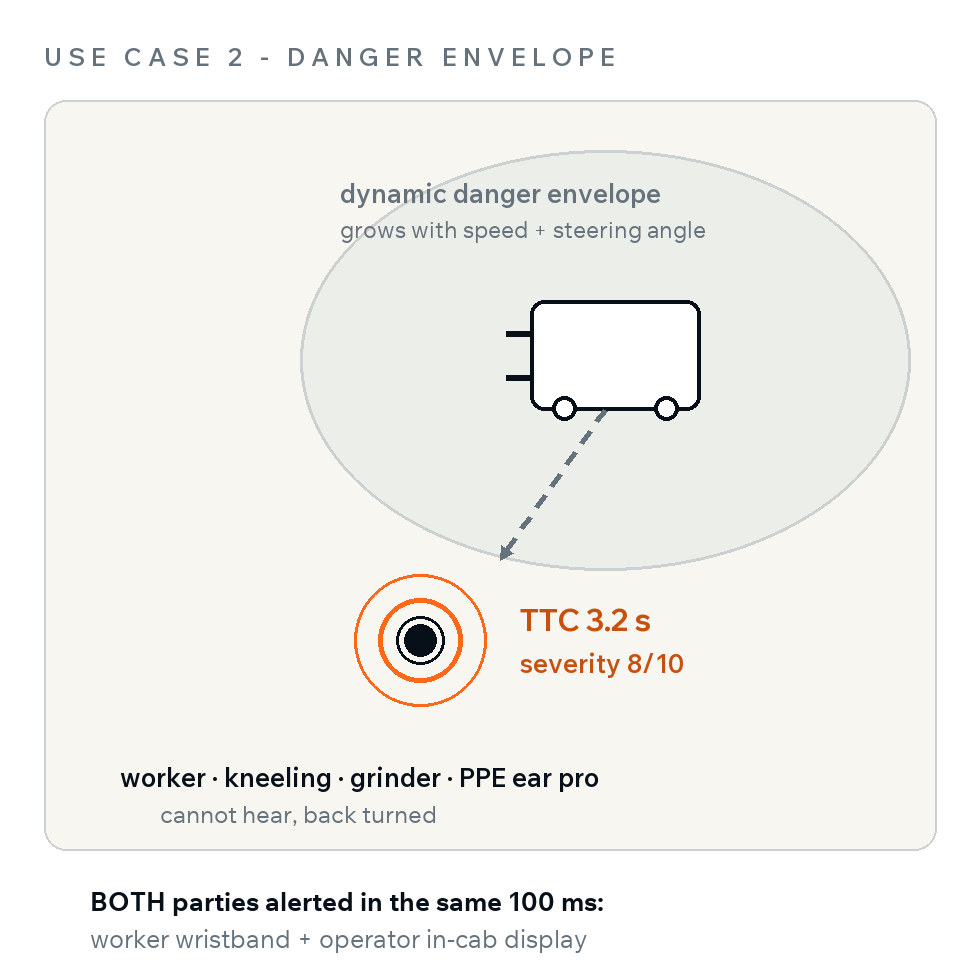
Struck-by incidents involving heavy machinery dominate the casualty statistics in industrial and heavy civil construction - Alberta’s #1 hazard. Here, a worker kneels to cut rebar with a grinder: hearing protection on, back turned, while a wheel loader manoeuvres behind him.
Neither human can perceive the other. The system can: it holds both trajectories in one coordinate frame, projects the loader’s dynamic danger envelope forward, computes the closing geometry, and classifies the approach at severity 8/10. The worker’s wrist erupts in a continuous high-priority pattern; the operator’s display flashes a proximity warning. The machine stops two seconds of travel away from a man who never saw it coming.
If the system prevented 15 forklift conflicts at one blind corner this week, the superintendent can redesign the traffic flow before anyone gets hurt. Terzonova turns near misses into actionable engineering data - and proves ROI by quantifying the trauma that did not happen.
“124 fall-risk approaches prevented this quarter.” Leading indicators that surface safety performance before an injury ever reaches the statistics - the data TRIR structurally cannot capture.
“Average 0.4 seconds from detection to acknowledgement.” Proof that alerts reach workers - and that workers act on them. The field-adoption metric that decides whether any safety technology is real.
“Zone C blind corner: 15 near misses this week.” A precise signal of where to change site layout, signage or traffic routing - risk engineering driven by evidence instead of anecdote.
Whether you are a contractor exploring a pilot, an owner setting safety standards, a broker looking for risk-engineering data, or an investor who wants to learn more - our team is ready to assist.