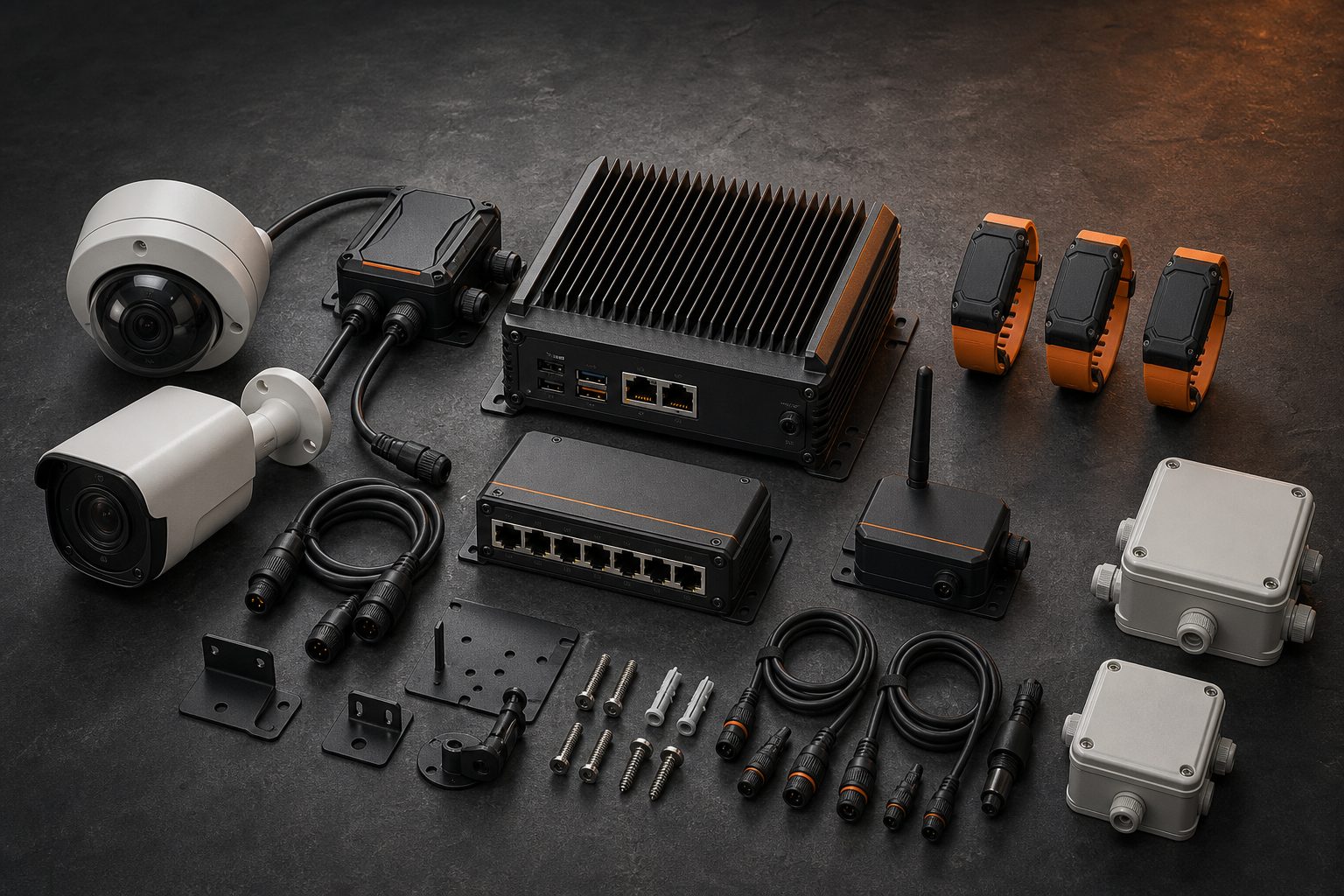
Every component below exists to defend one number: an alert on a worker’s wrist in under 500 milliseconds - in dust, rain, −30°C and 100-decibel noise, with or without an internet connection. This is the complete site kit, the network engineering behind it, and the deployment process that makes it repeatable.
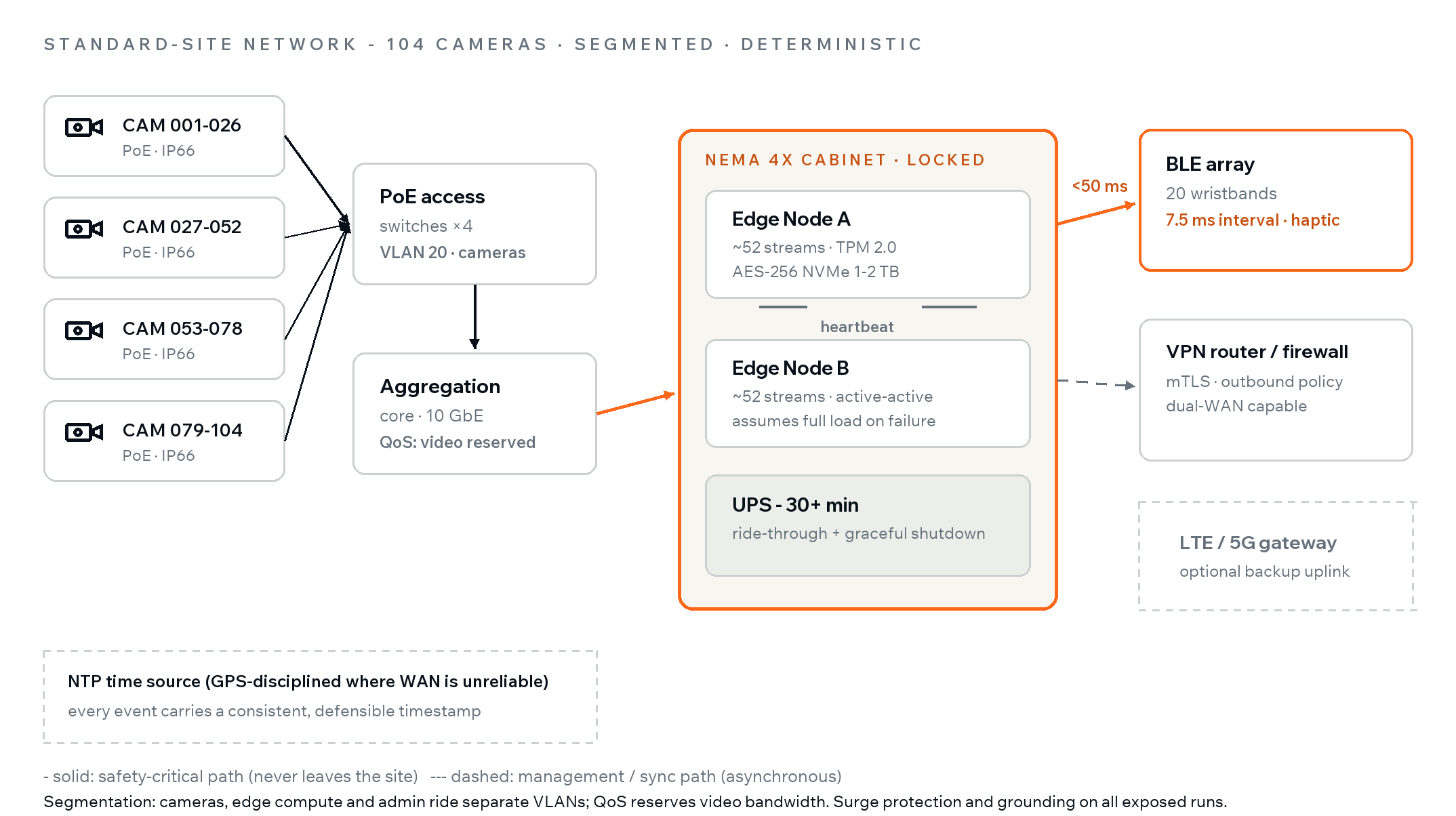
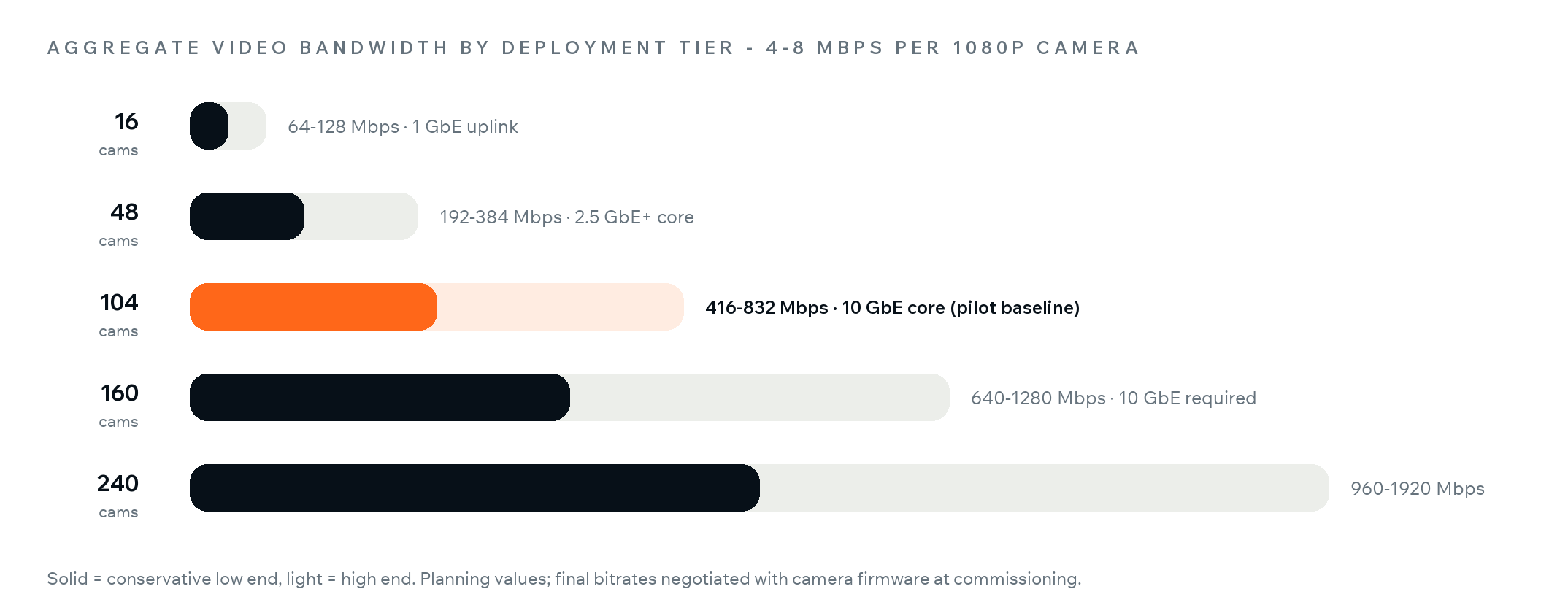
The network’s job is deterministic: move video from 104 cameras to the edge nodes with low jitter, deliver BLE alert packets across the active work zone, and keep the safety network isolated from everything else on site. Stability beats theoretical throughput.
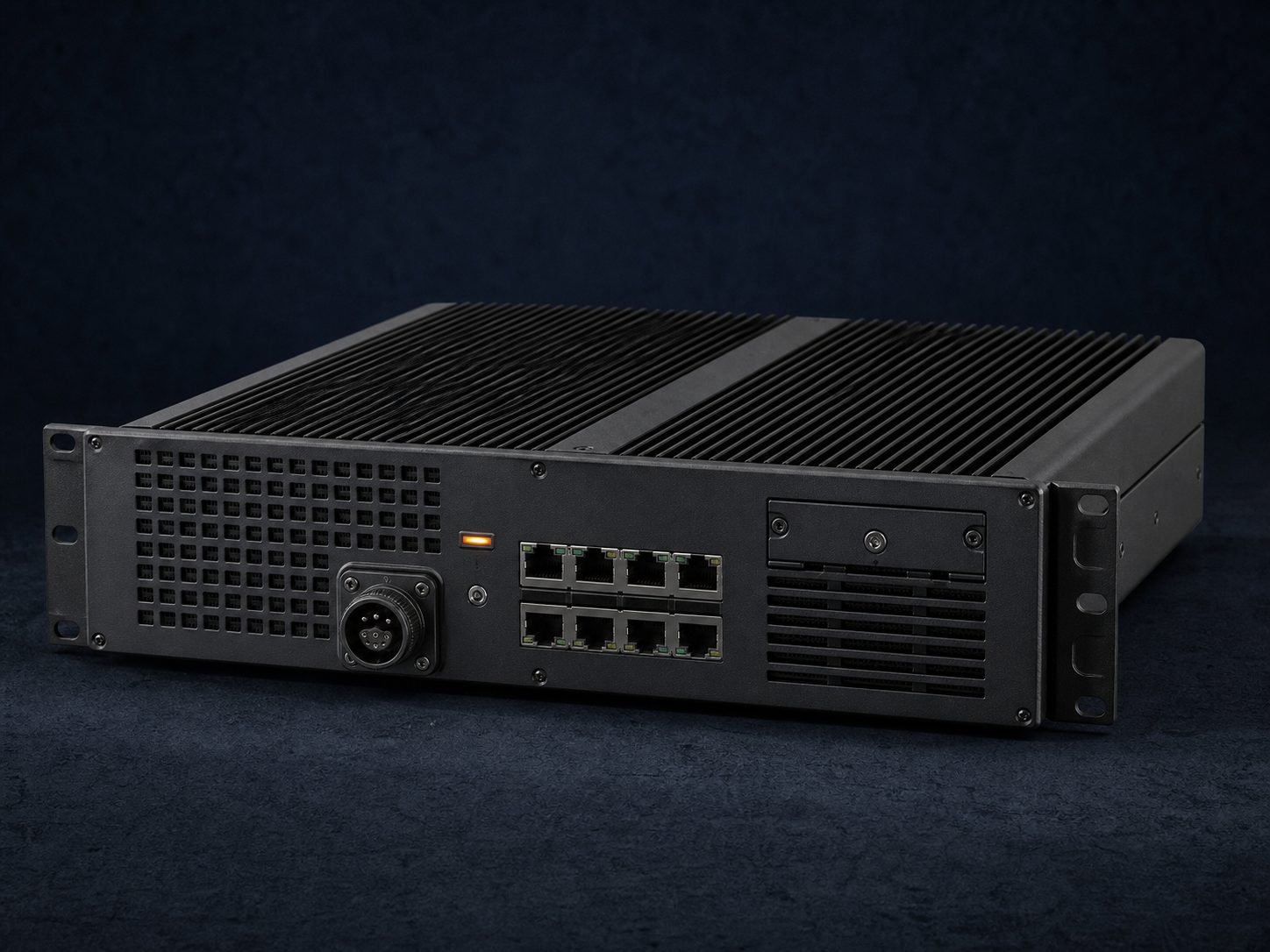
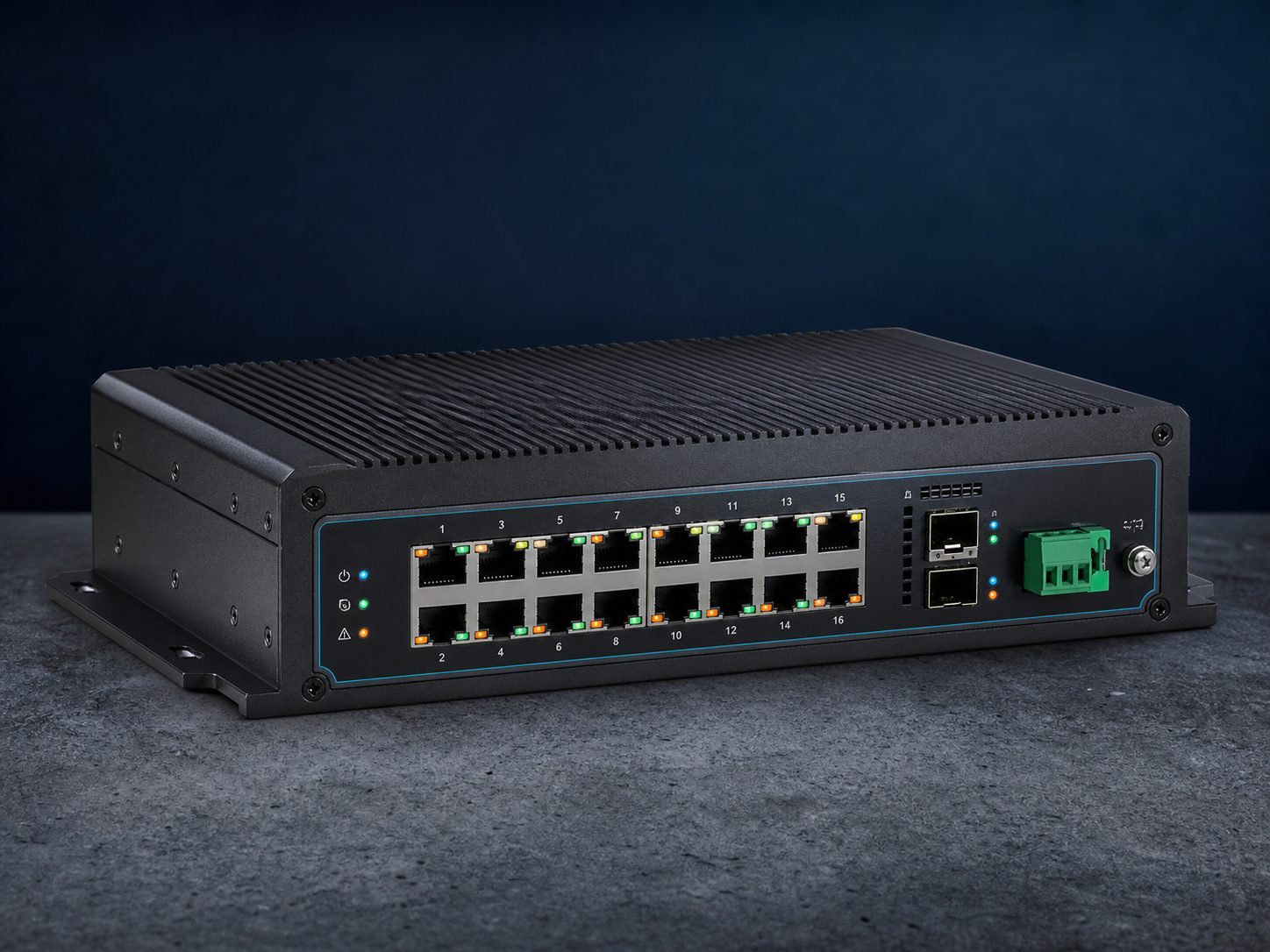
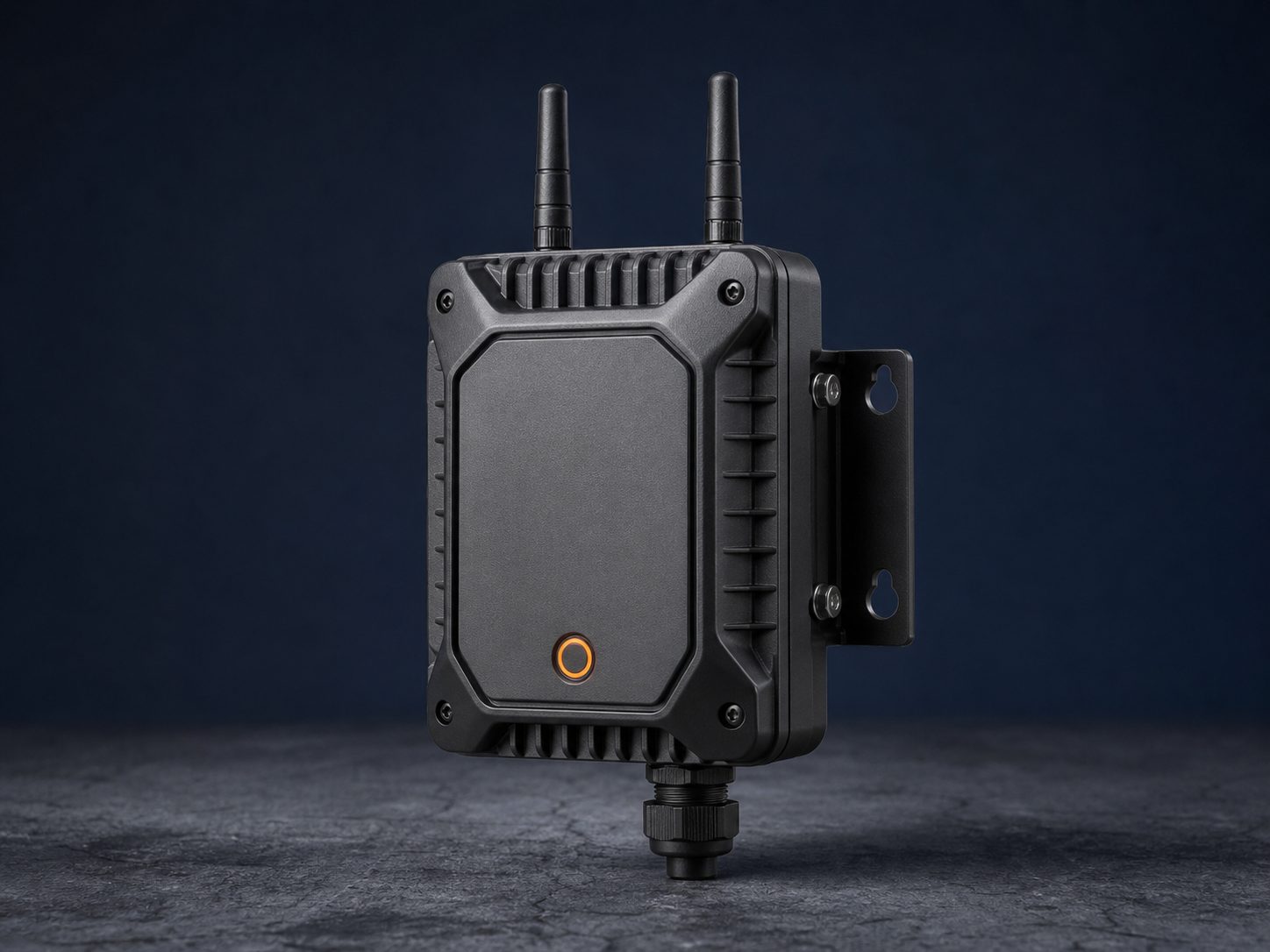
The edge node runs the wireframe AI and the hazard rules engine locally - which makes its integrity a safety property. Secure boot and measured boot (TPM 2.0) prevent unauthorized modification; AES-256 full-disk encryption makes a stolen node worthless; hardware health telemetry feeds the cloud fleet monitor.
The two-node active–active cluster is the simplest possible high-availability design: both nodes process ~52 camera streams each and exchange heartbeats. If one dies, the survivor absorbs its load in seconds. A per-cabinet UPS provides 30+ minutes of ride-through for generator transfers - and a graceful shutdown in a full blackout, preventing data corruption.
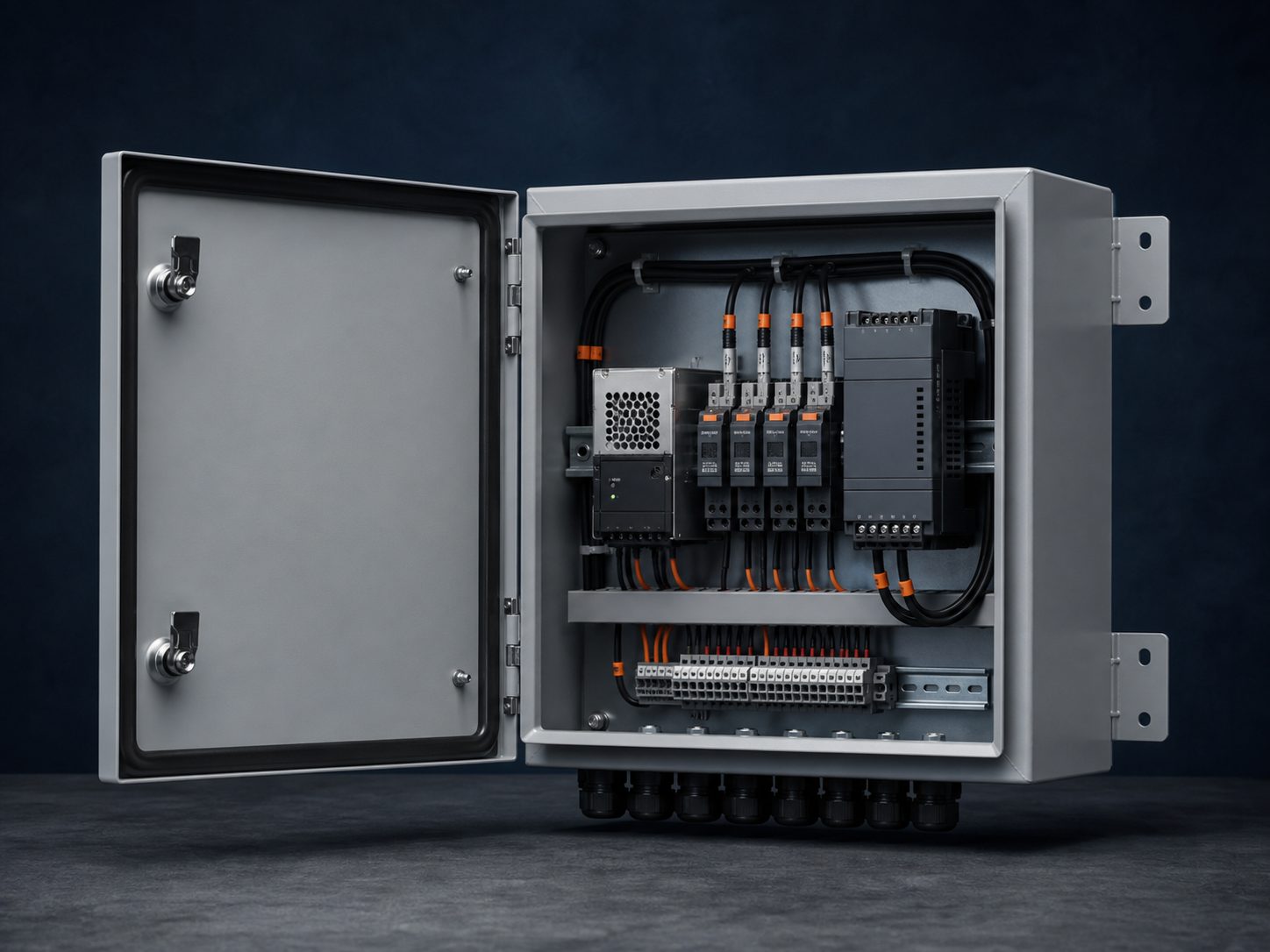
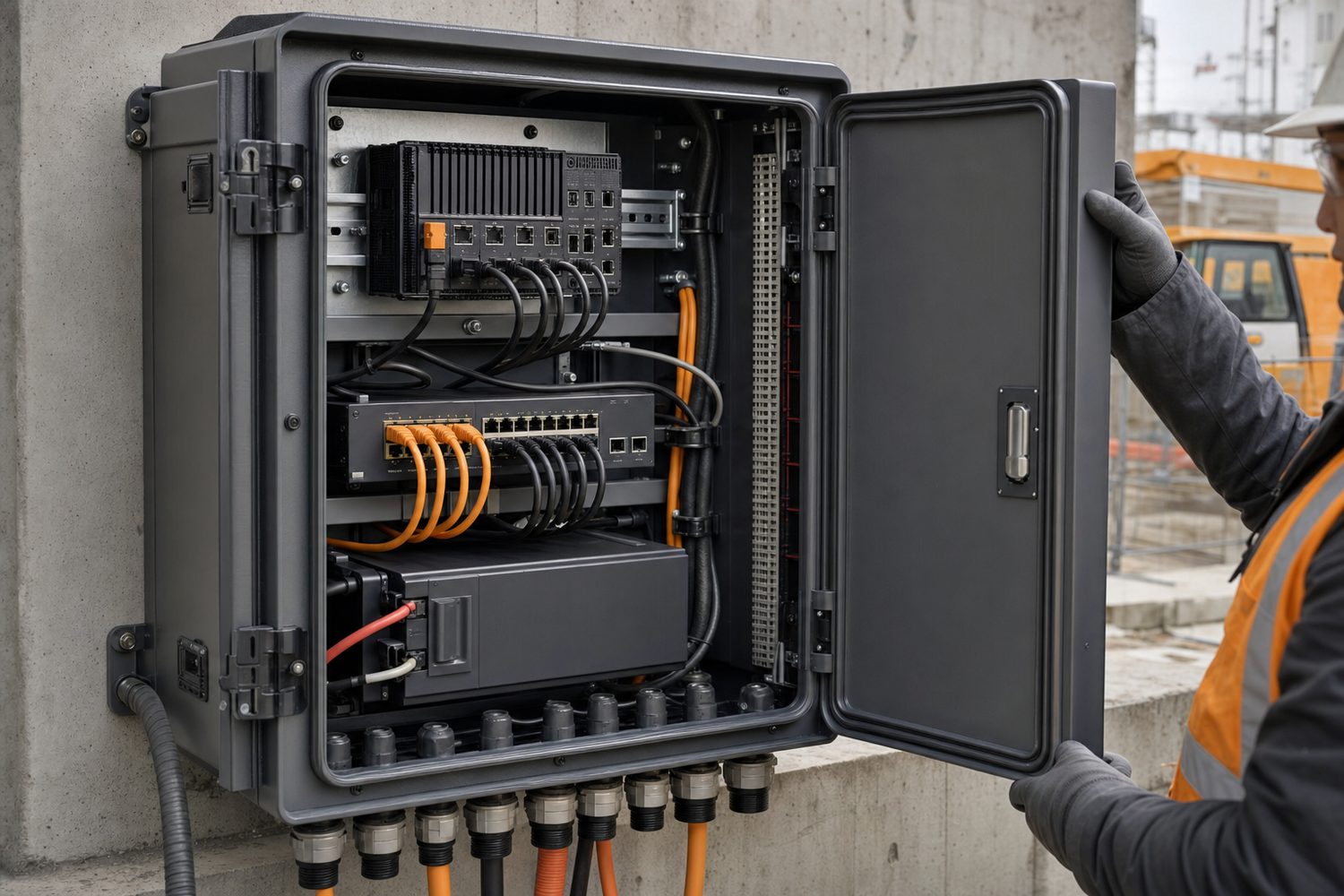
Everything lives in a lockable NEMA 4X enclosure with filtered ventilation, cable glands, a grounding bus and heating for Canadian winter operation. This baseline is deliberately “over-reliable”: fault tolerance is cheaper than a single missed alert.
| Component | Baseline specification |
|---|---|
| TZ-EDGE-100 node ×2 | Industrial x86 (OnLogic class) · secure boot · 32–64 GB RAM · 1–2 TB encrypted NVMe · dual+ Ethernet · health telemetry |
| Root of trust | TPM 2.0 with measured boot; holds device-identity and event-signing keys |
| UPS | ≥30 min runtime for compute + core network at expected load |
| Enclosure | NEMA 4X lockable cabinet · filtered ventilation · cable glands · grounding bus |
| Thermal | Filtered fans, temperature monitoring, heater for −30°C winter operation |
| Compute strategy | Full 25–30 FPS on high-risk zones, sampled FPS elsewhere; wireframe optimization holds the 300 ms inference budget |
Placement is driven by risk zoning - vehicle routes, hoist zones, material laydown, high-energy work fronts - not square footage. For struck-by hazards we care about eliminating blind spots in travel corridors and equipment interfaces; for compliance analytics we care about consistent visibility of defined hazard zones over time, so alerts, near misses and corrective actions attribute to the correct zone and shift.
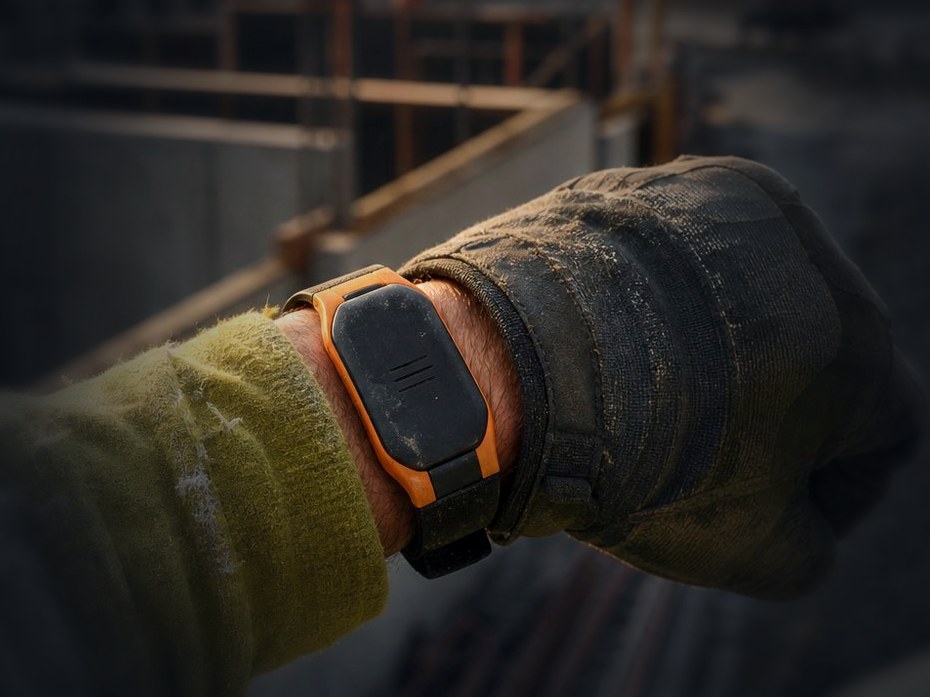
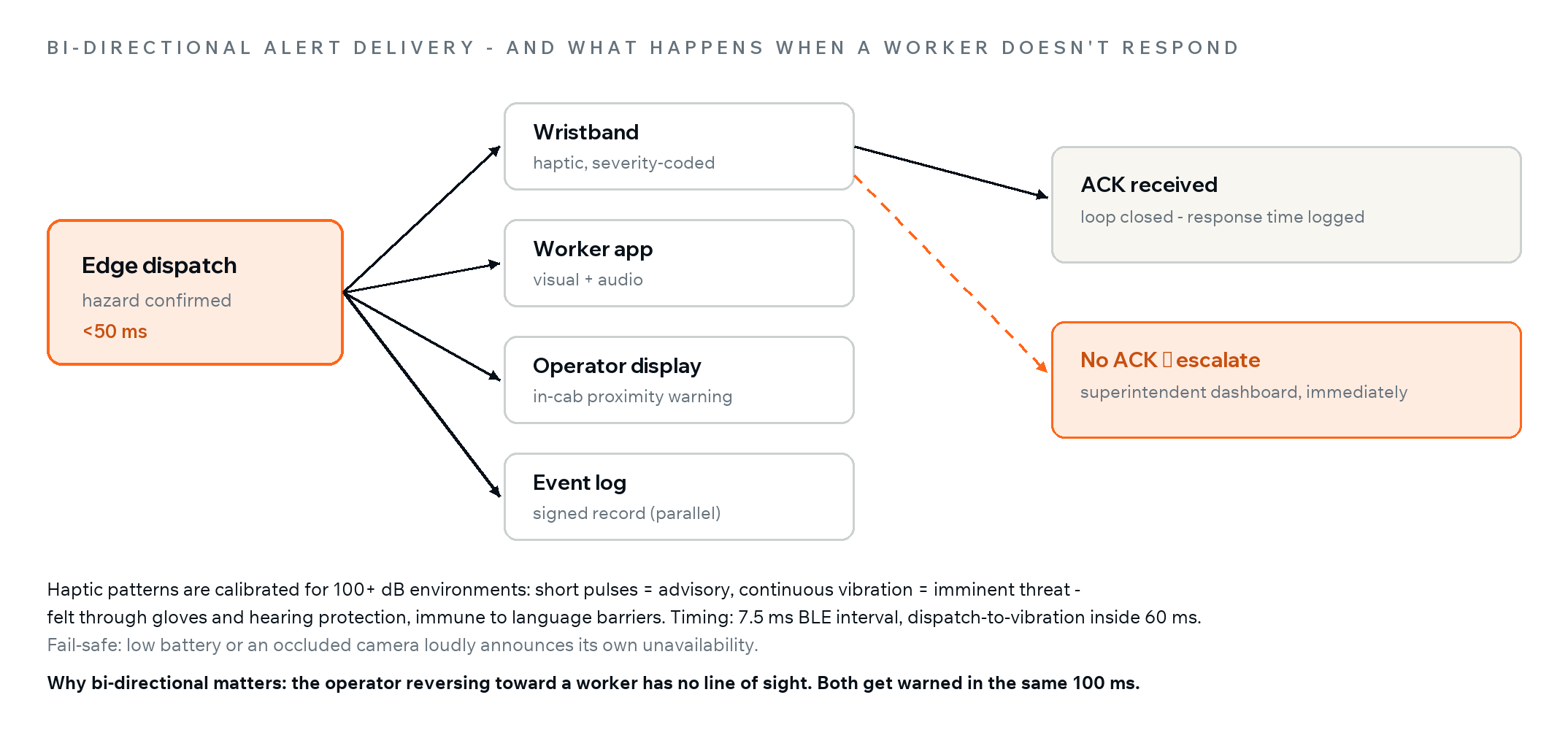
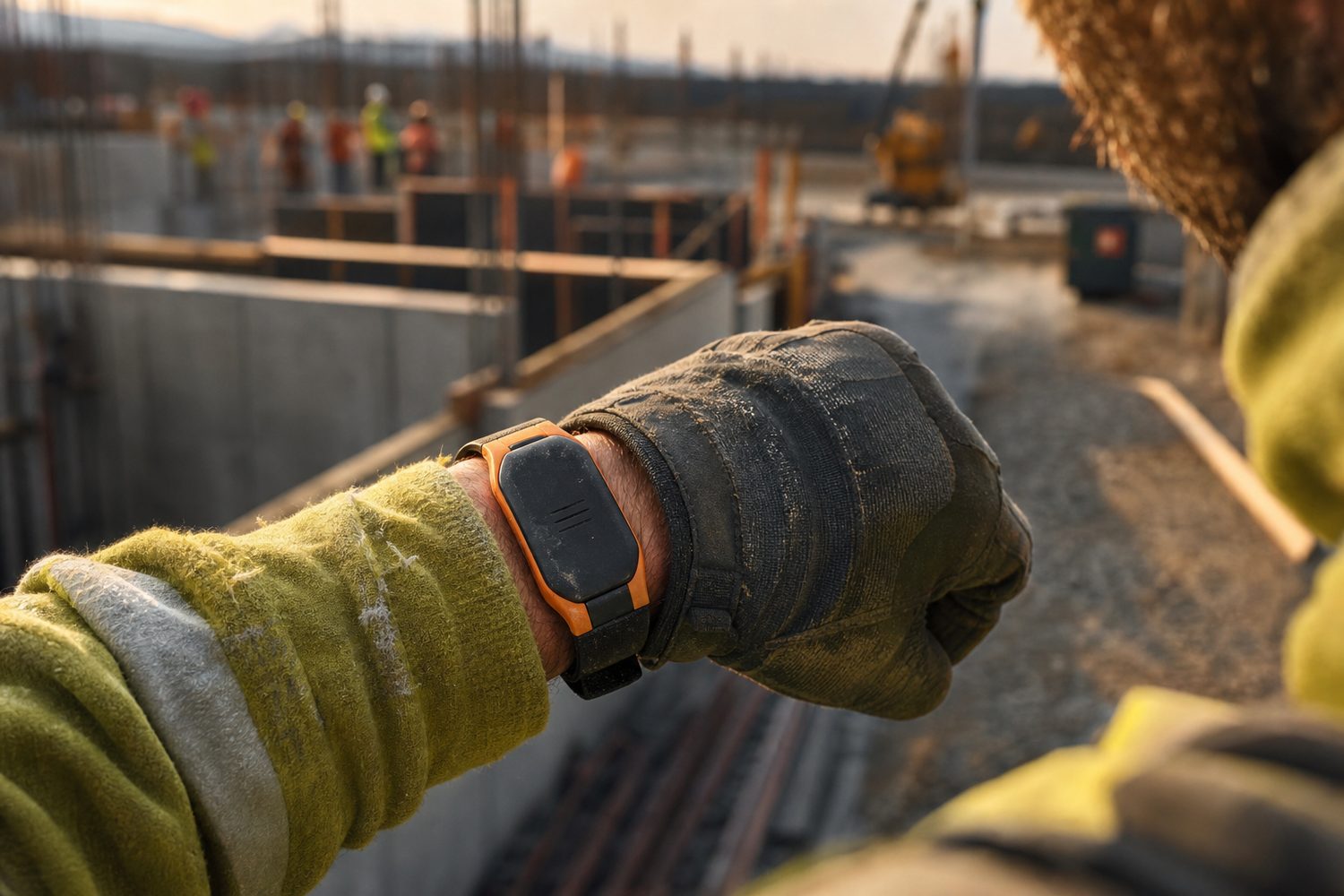
On a construction site, audio alarms fight 100+ decibels of ambient noise, hearing protection and language barriers - and lose. A vibration on the wrist doesn’t negotiate with any of that. The wristband is an alert receiver, not a tracking device - a distinction backed contractually by the Worker Data Bill of Rights.
Issue at shift start, return at shift end, dock overnight in multi-device charging stations aligned to shift patterns, with a 10% spares buffer against loss and damage. Wearables are managed site assets - high adoption with zero administrative drag on the superintendent.
A low wristband battery or an occluded camera triggers an immediate, loud unavailability notification - so no worker ever unknowingly relies on a dark unit, and no manager discovers a coverage gap from an incident report.
Short pulses for advisory warnings; continuous vibration for imminent threats. Fifty false buzzes a day would kill trust permanently - which is why the 4.2% false-positive target and the shadow-mode calibration week exist.
Poor commissioning creates nuisance alarms, nuisance alarms destroy worker trust, and lost trust kills safety systems. So we front-load correctness: every deployment follows the same engineered sequence, each phase gated by a concrete deliverable.
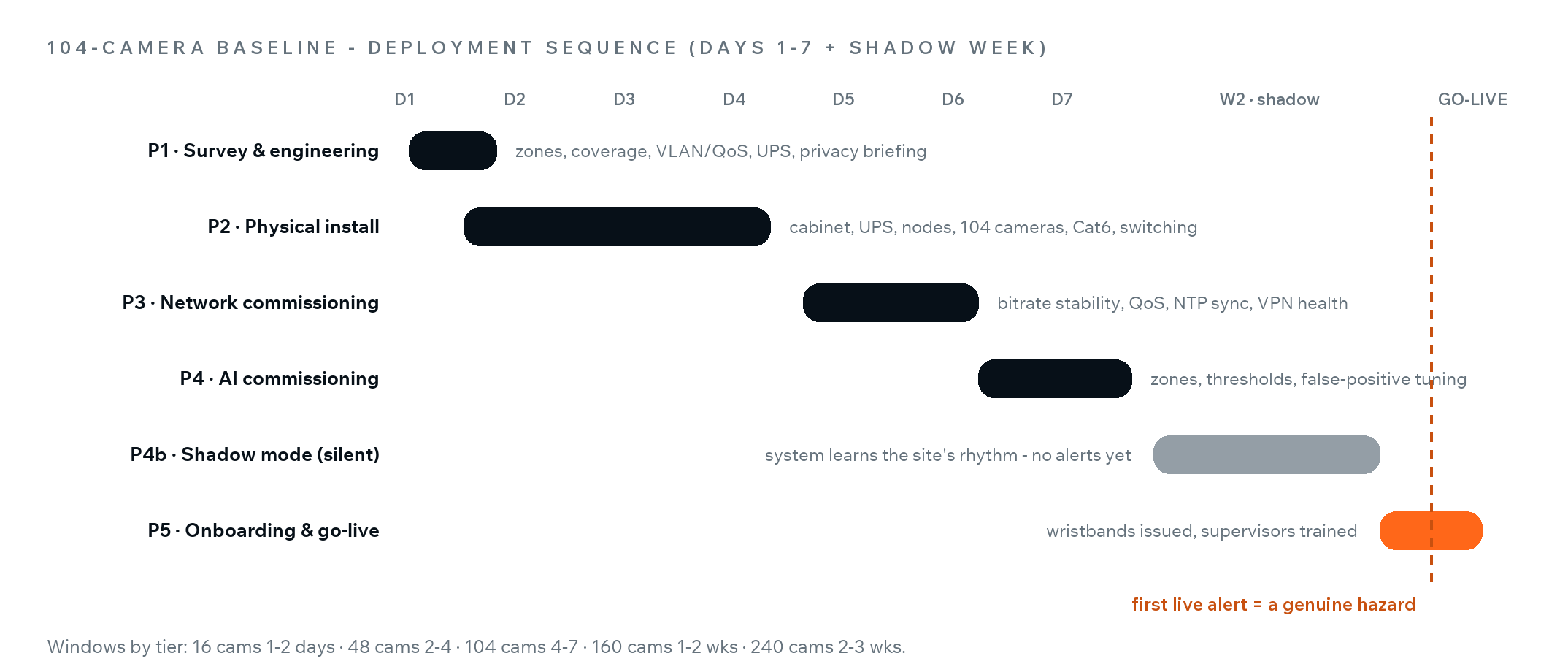
Hazard-zone mapping aligned to site logistics, camera coverage plan with fields of view and lighting, VLAN/QoS topology, UPS and grounding plan, and a PIPEDA-aligned worker communications briefing.
All cameras reachable, labeled and streaming RTSP to edge compute; secure boot and telemetry validated; bitrate stability and packet loss verified under peak load; QoS enforcement, NTP sync and VPN health confirmed.
Zones, thresholds and routing configured; false-positive tuning against site-specific lighting, dust and occlusion; a documented acceptance test showing the end-to-end loop inside budget under representative conditions - then wristbands, training, go-live.
Each tier is a procurement, installation and commissioning package we can execute repeatably - priced by the same per-unit formulas as the baseline site, with edge node counts preserving failover headroom at every scale.
| Tier | Cameras | BLE wristbands | Edge nodes | Install window | One-time setup | Monthly service |
|---|---|---|---|---|---|---|
| Small works | 16 | 10 | 1 | 1–2 days | $6,700 | $2,821 |
| Standard site | 48 | 20 | 2 | 2–4 days | $10,200 | $3,391 |
| High-coverage baseline PILOT | 104 | 20 | 2 | 4–7 days | $15,800 | $3,951 |
| Enterprise multi-zone | 160 | 40 | 3 | 1–2 weeks | $22,000 | $4,811 |
| Mega-project | 240 | 60 | 4 | 2–3 weeks | $30,600 | $5,911 |
Setup = $4,800 + $100/camera + $30/wristband · Monthly = $2,411 + $10/camera + $5/worker + $200/node. Full unit economics →
Edge nodes and wearables designed to comply with Canadian Standards Association electrical safety standards and UL certification for harsh-environment operation.
BLE transmission compliant with Innovation, Science and Economic Development Canada requirements, with FCC compliance for planned U.S. expansion.
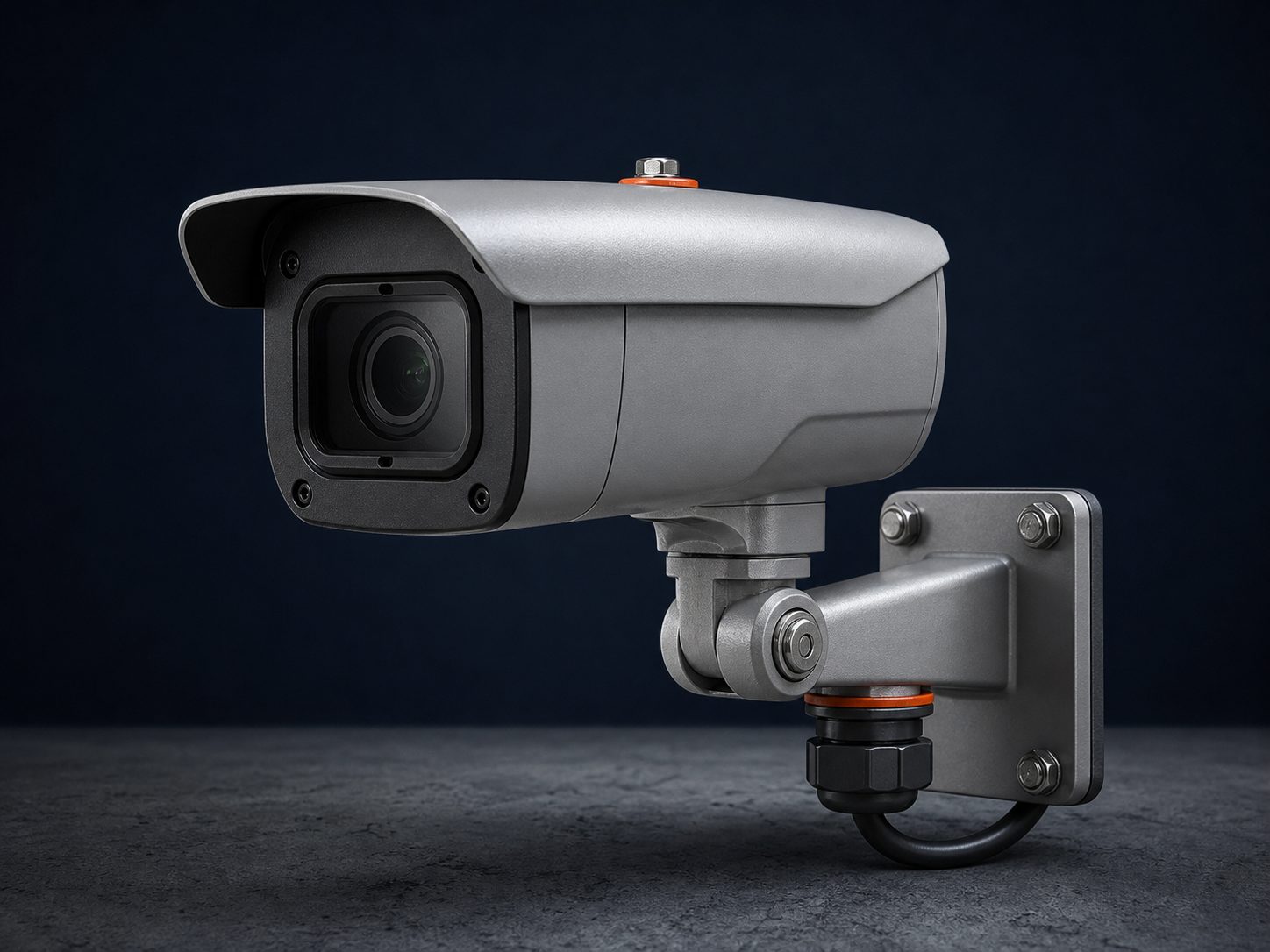
Cameras rated IP66 against dust and driven rain; compute enclosures rated NEMA 4X with thermal management for −30°C winter operation. Durable lifecycles minimize electronic waste.
Detection logic adapted to Canadian fall-protection (Z259) and workplace electrical safety (Z462) standards as part of provincial localization.
Whether you are a contractor exploring a pilot, an owner setting safety standards, a broker looking for risk-engineering data, or an investor who wants to learn more - our team is ready to assist.