From privacy and union concerns to latency claims and pricing mechanics - if your question isn’t answered below, write to us and it will be.
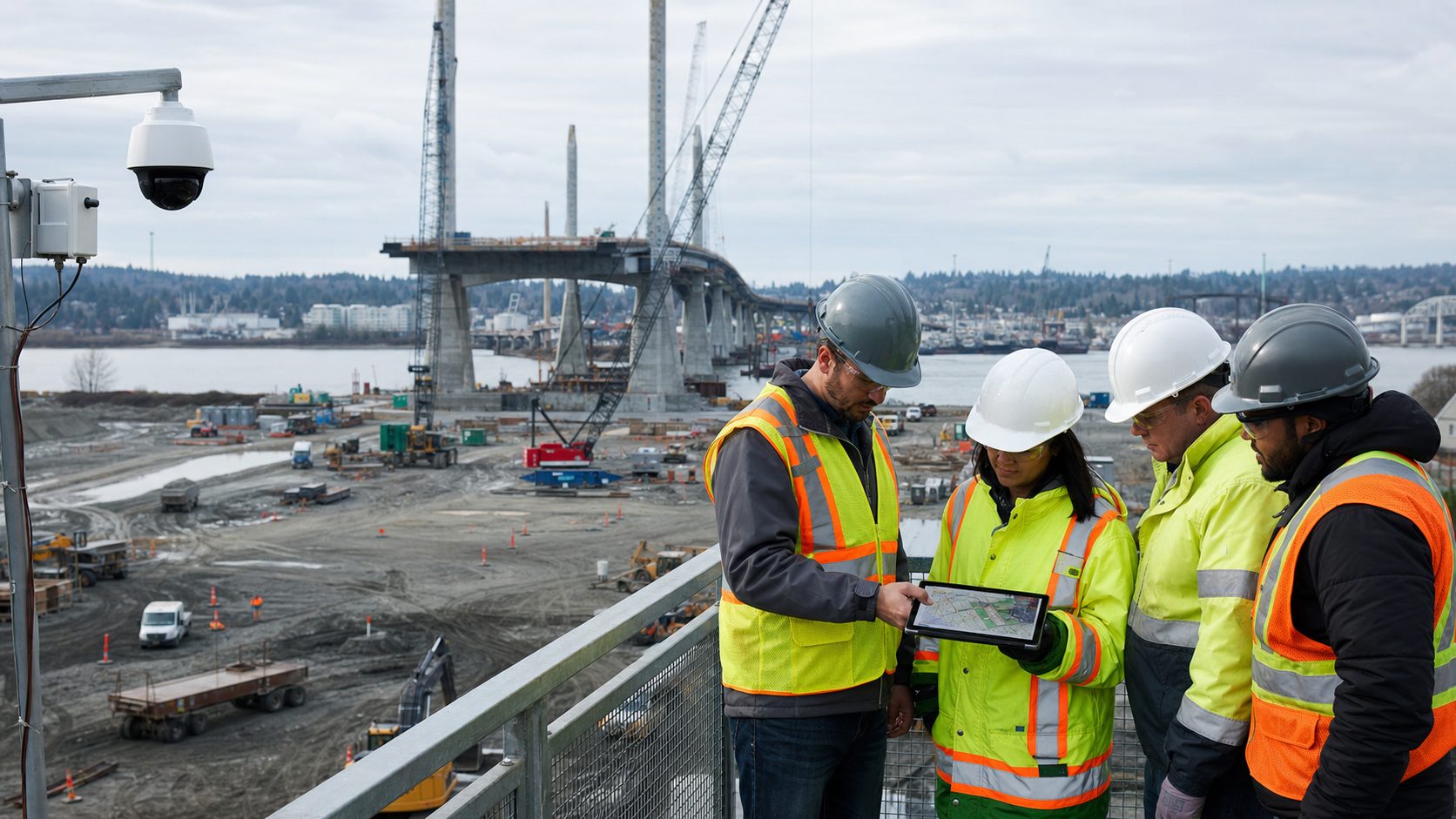
Terzonova is a business-to-business safety platform for construction sites. It combines on-site cameras, an edge AI computer, vibrating worker wristbands and a compliance dashboard. The system detects high-risk events as they develop, warns the people involved in under half a second, and automatically documents every event for regulators, auditors and insurers.
Tools like Procore Safety or HCSS digitize paperwork: a person notices a hazard and types it in. Terzonova watches the site itself, predicts hazards 3–5 seconds before they materialize, physically warns the workers involved, and then fills in the paperwork automatically. It protects first and documents second - existing tools only document.
Yes - because nothing leaves the site. The budget is engineered stage by stage: RTSP ingestion under 100 ms, wireframe AI inference around 300 ms, rules evaluation 20–40 ms, and alert dispatch with BLE haptic delivery inside 60 ms - the wristband radio is already listening on a 7.5 ms connection interval. Worst case, the four stages close under 500 ms. Cloud competitors cannot match this for a structural reason: their 2–5 second network round trip is built into their architecture. Each deployment’s acceptance test demonstrates the full loop under representative site conditions before go-live.
The detection models cover the major killers in Canadian construction: worker–machine proximity and struck-by scenarios, fall risks at leading edges and open excavations, caught-in/between hazards, electrical proximity zones, suspended-load exposure, and PPE compliance (hard hats, high-visibility vests) with a 95% detection-accuracy target. Site-specific risk zones - crane swing paths, vehicle corridors, exclusion areas - are configured during onboarding.
Nothing - and that is the point. The entire safety loop (cameras, edge AI, wristbands) runs on local hardware and needs no internet handshake. Detection, prediction and alerting continue uninterrupted. Signed compliance records buffer on encrypted local storage and synchronize automatically when connectivity returns. No data is lost and no protection is interrupted.
No. Video is analyzed on the site itself and converted into anonymous wireframe figures; the raw footage is discarded immediately. Nothing identifiable is stored or sent to the cloud, and there is no facial recognition. What remains is structured event data - for example, “a worker entered Zone B at 14:32 and was alerted.” Short context clips around confirmed safety events are the only imagery retained, and they are signed and access-controlled.
No - contractually. Our Worker Data Bill of Rights explicitly bans the use of Terzonova data for disciplinary action regarding work speed or breaks, and the document is designed to be shared directly with union representatives. Break areas and public roadways are privacy-masked before analysis, there is no tracking during breaks, and wristbands are alert receivers, not location trackers.
By architecture. Data minimization is physical: video is processed on the device and destroyed; only metadata leaves the site. Purpose limitation, worker consent practices and granular access controls are built into the platform, and the “no video storage” posture future-proofs deployments against tightening privacy law. See our Privacy Policy for the full framework.
Alarm fatigue is the single biggest killer of safety technology, which is why false-positive suppression is a core engineering discipline here - not a tuning afterthought. Visual context, temporal smoothing and severity tiers drive a 4.2% false-positive target versus the 18–23% industry norm, and every new site runs a silent shadow-mode week so the system learns the site’s rhythm before the first alert ever fires. The first buzz a worker feels should be a real hazard.
The system announces its own unavailability. Low-battery wristbands and occluded cameras trigger immediate fail-safe notifications so nobody unknowingly relies on a dark unit. Charging stations and a 10% spares buffer are part of every deployment, and fleet health monitoring opens a support ticket the moment any component degrades.
Usually not. Terzonova ingests standard RTSP streams - the protocol most modern IP cameras already use - so the platform layers intelligence on top of existing infrastructure. We supply additional IP66 cameras only where risk-zone coverage has gaps.
A 16-camera small-works site takes 1–2 days; the 104-camera baseline takes 4–7 days; mega-projects of 240 cameras take 2–3 weeks. Our engineers run the survey, installation, network commissioning and AI tuning; a dedicated Success Engineer owns the first 30 days. The site team’s only new task is issuing wristbands at shift start - deliberately zero added paperwork.
Pricing follows two transparent formulas. Setup: $4,800 base + $100 per camera + $30 per wristband - $15,800 for the standard 104-camera site. Monthly: $2,411 base + $10 per camera + $5 per worker + $200 per edge node - $3,951 for the same site. This covers the SaaS platform, managed hardware lifecycle, support and connectivity. Full tiers from small works ($6,700 setup / $2,821 monthly) to mega-project ($30,600 / $5,911) are on the Business page.
Honest answer: Terzonova provides the evidence, not the guarantee. The platform produces the leading-indicator data - prevented incidents, response times, validated claims performance - that can support premium discussions, insurer risk-engineering credits and experience-rating improvements. Outcomes depend on each province’s workers’ compensation rules, your claims history and insurer underwriting. What we can say: we are structuring broker and carrier partnerships precisely so that documented prevention translates into financial recognition.
The compliance engine launches with 147 mapped Ontario OHSA-related duties and provisions, with WorkSafeBC (BC), Alberta OHS and CNESST (Quebec) modules in development on a rules-agnostic architecture that switches provincial modules with a configuration change. Alerts and interfaces are fully bilingual English/French.
Terzonova is contractually and functionally an Assistive Awareness Tool - an additional technical layer that augments, never replaces, human supervision and mandatory safety protocols. Existing OHSA duties, supervision requirements and safety programs remain fully in force. We carry errors-and-omissions and product liability insurance specifically underwritten for safety-critical hardware, and the platform’s signed event logs typically strengthen a contractor’s due-diligence position rather than complicate it.
We are selecting eight pilot sites across Ontario and British Columbia with general contractors, project owners and insurance brokers; deployments begin once engineering build-out completes. Pilots run with clear KPIs, a shadow-mode calibration week, a dedicated Success Engineer for the first 30 days, and a pre-defined path from pilot to fleet rollout with founding-partner terms. Contact us to start the conversation.
Whether you are a contractor exploring a pilot, an owner setting safety standards, a broker looking for risk-engineering data, or an investor who wants to learn more - our team is ready to assist.