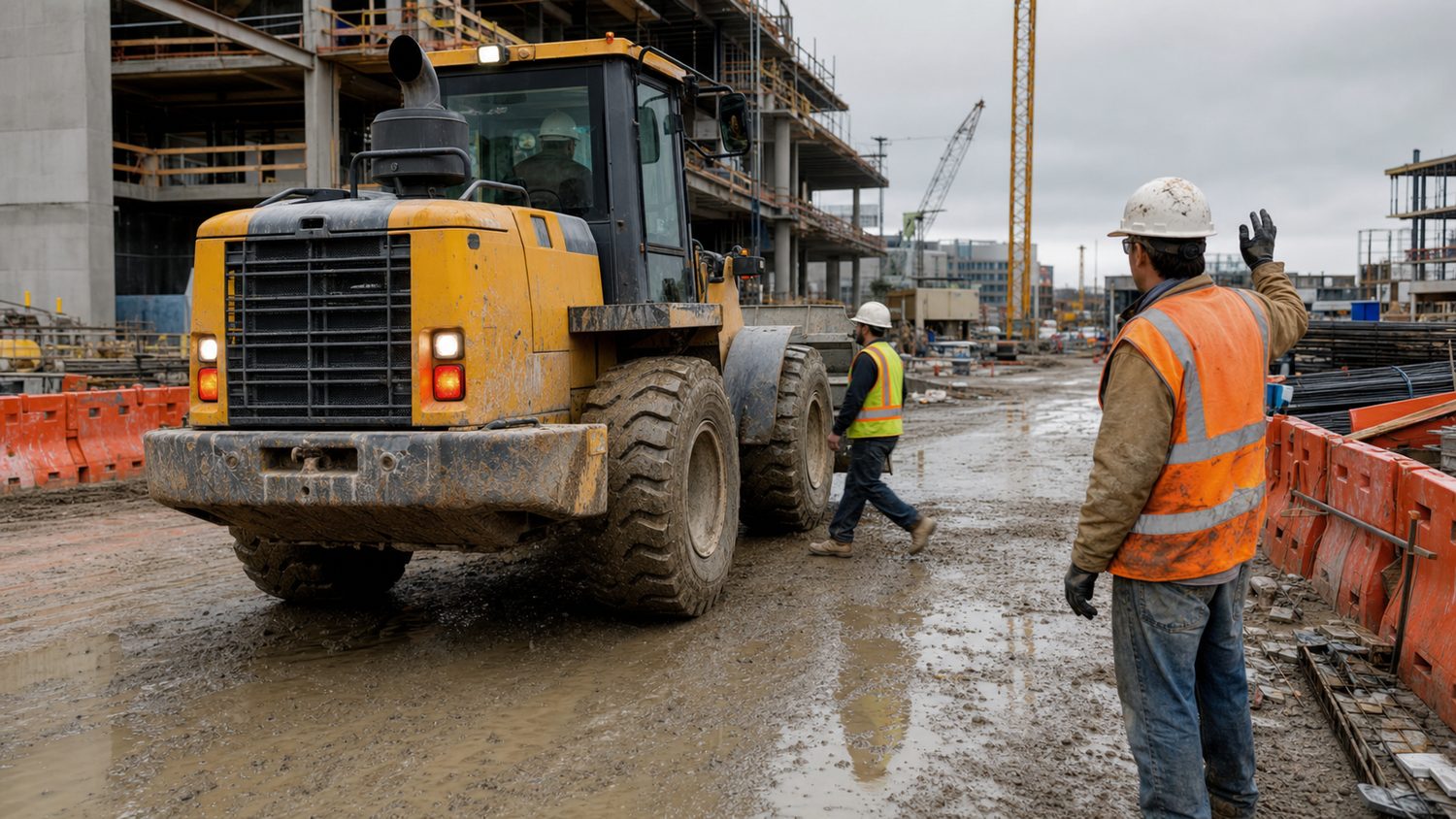
Construction contributes $164.5 billion to Canada’s GDP and employs 1.6 million people. It also kills more of its workers than any other sector - not because the industry doesn’t care, but because its safety model was designed for a world without real-time data. This page is the evidence that the model has hit its ceiling.
The Association of Workers’ Compensation Boards of Canada tracks every accepted workplace injury and fatality claim in the country. Construction’s 2022 numbers are not an anomaly - they are the plateau the industry has been stuck on for years.
Of 993 accepted workplace fatalities recorded across Canada in 2022, construction accounted for 183 - more than any other sector, and more than one in every six.
Where enforcement and prevention investment concentrate, the line moves: BC construction death claims have fallen two years running.
Sources: AWCBC National Work Injury/Disease Statistics Program (2022 accepted claims); WorkSafeBC data as reported by Business in Vancouver, 2026. Fatalities include occupational disease and are recorded in the year the claim is accepted.
Take the most ordinary hazard on any industrial site: a worker and a machine converging on a blind corner. Run the numbers, and the problem stops being about culture or diligence - it becomes a race against a clock that human biology cannot beat.
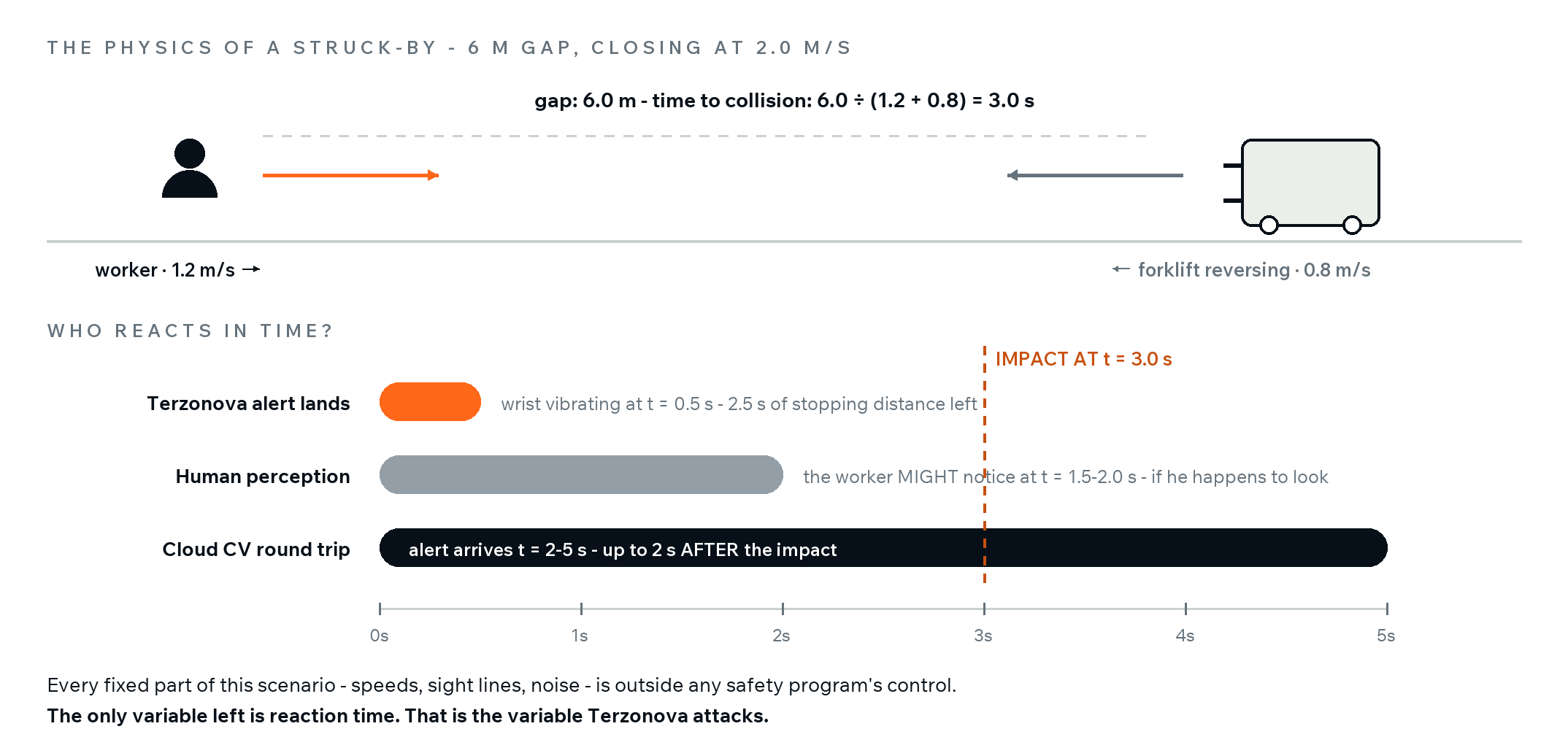
Human reaction time to an unexpected event averages 1.5–2.0 seconds - and that assumes the worker is looking the right way. Hearing protection, 100+ dB ambient noise and task focus routinely remove the sensory channel entirely.
An excavator operator reversing toward a worker may have no line of sight at all. No amount of training gives the operator eyes in the back of the machine, or the kneeling worker ears through his ear protection.
A superintendent cannot watch 50 workers across a multi-trade site. Spot-check supervision leaves coverage gaps where a removed harness or a breached exclusion zone goes unseen until it becomes an incident report.
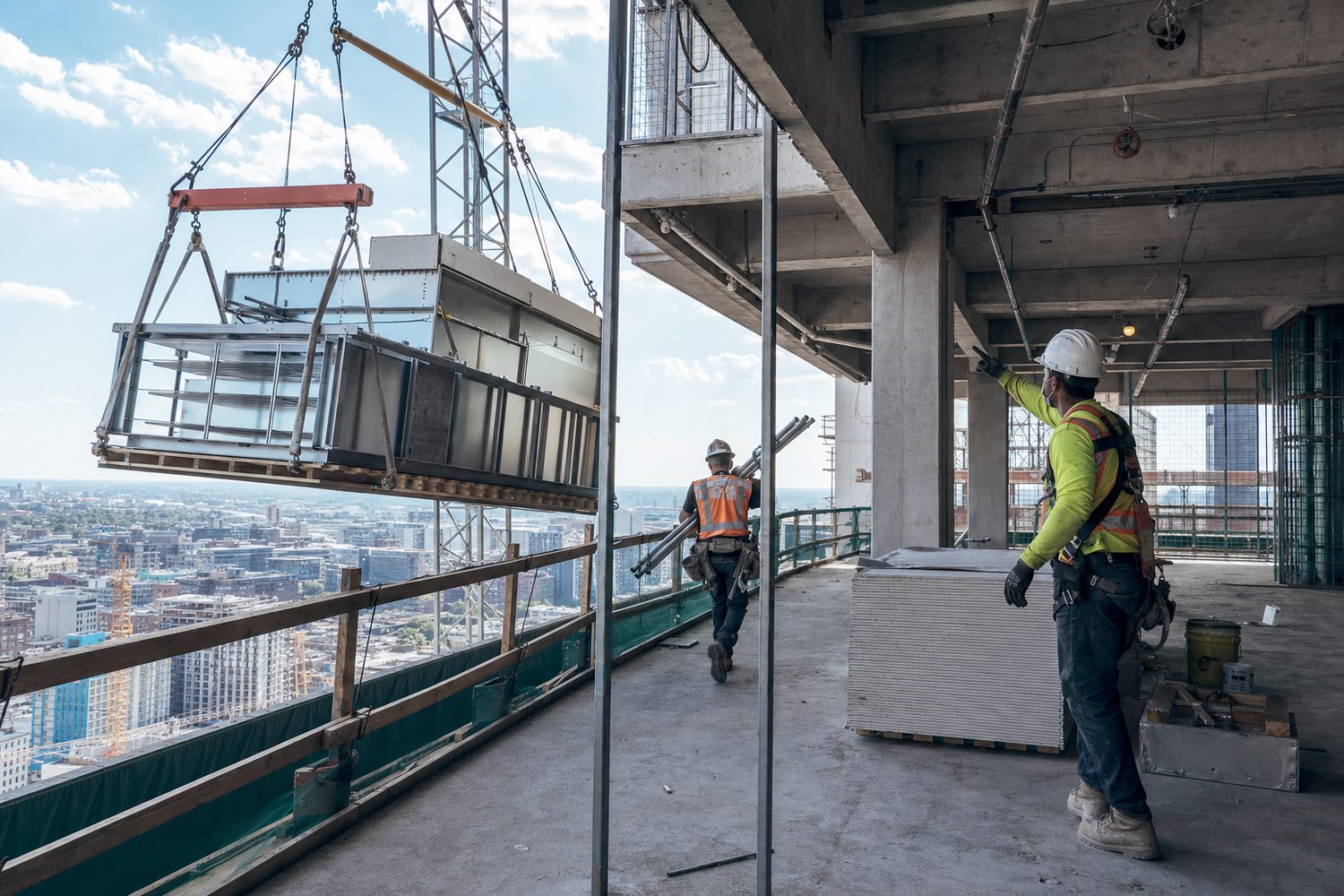
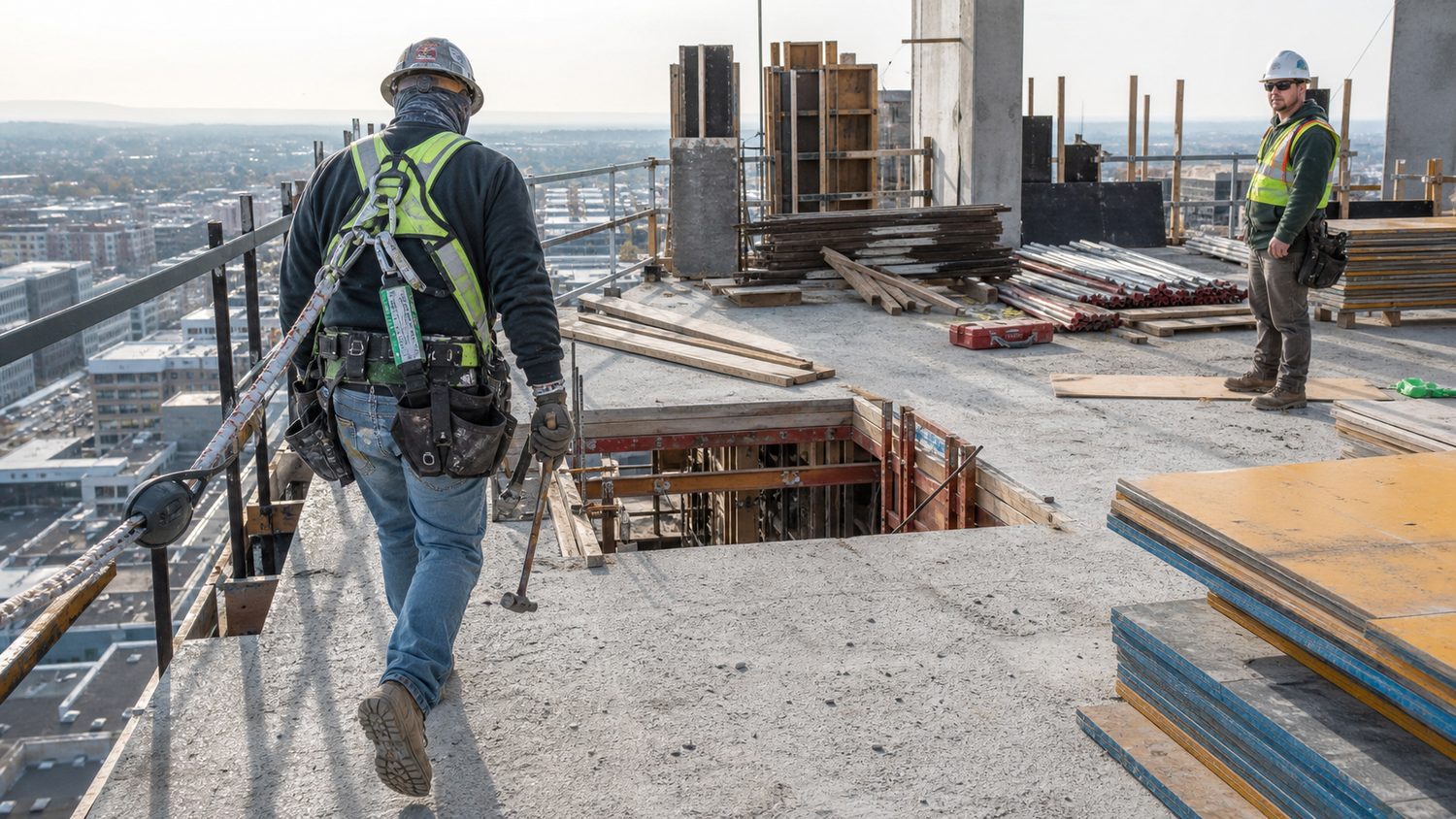
Everything the industry uses to manage safety today - supervision, incident reports, TRIR scores, insurance pricing - is built on information generated after someone gets hurt. That is not a culture problem. It is an architecture problem.
The industry’s standard metric - Total Recordable Incident Rate - counts injuries that already happened. It says nothing about the hundred near misses that preceded each one. Contractors are left “fixing safety culture” after the injury, while safety officers burn 15+ hours a week producing rear-view-mirror paperwork instead of coaching crews.
Carriers underwrite construction on historical claims, not on how a site actually behaves today. Safe contractors subsidize unsafe ones; premiums keep hardening; and no insurer can reward genuine prevention because no objective, real-time measure of “safe” has ever existed. The claims volatility lands on everyone’s loss ratio.
Provincial bodies are burdened with investigating accidents that were preventable - and without immutable, objective data, liability determination is slow and litigious. Inspectors reconstruct events from contradictory testimony and paper forms filled in after the fact.
Fatigue, time pressure, subcontractor churn, language barriers, noise, blind spots - every one of these weakens compliance in real time, in exactly the window where no existing tool operates.
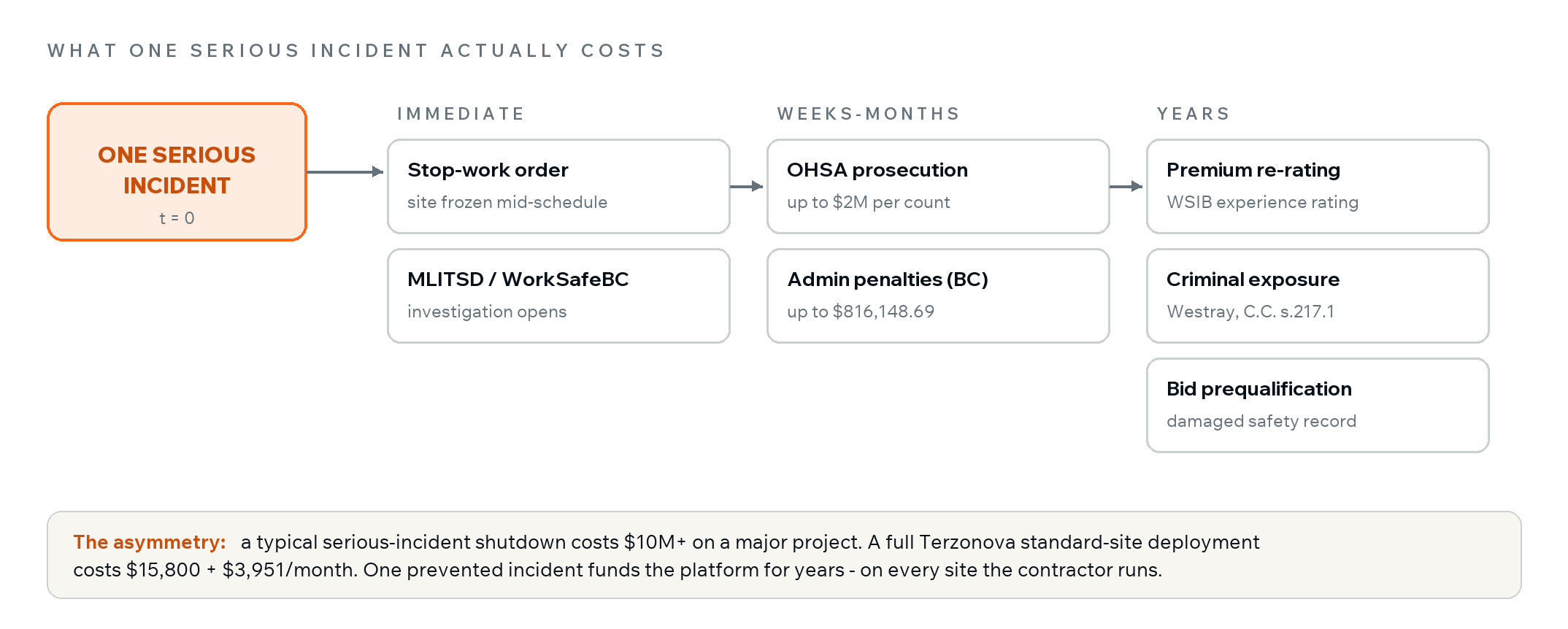
Regulators have responded to the fatality plateau the only way they can: by raising the price. Ontario’s Bill 79 lifted the maximum corporate OHSA fine to $2 million per count - the highest in Canadian history. WorkSafeBC’s administrative penalty ceiling reached $816,148.69 for 2026 and recalculates upward each year. Meanwhile the construction insurance market has hardened: coverage is increasingly conditioned on demonstrable, data-driven risk management.
| Jurisdiction | Maximum exposure | Instrument |
|---|---|---|
| Ontario | $2,000,000 / count | OHSA s.66(2), as amended by Bill 79, Working for Workers Act 2023 |
| British Columbia | $816,148.69 (2026) | Workers Compensation Act s.95(2) statutory maximum, indexed annually |
| All provinces | Premium re-rating | WSIB / WorkSafeBC employer-level experience rating |
| Criminal (federal) | Unlimited fines | Westray amendments, Criminal Code s.217.1 duty of care |
| Project level | $10M+ exposure | Stop-work orders and schedule collapse after serious incidents |
Sources: Government of Ontario (Bill 79); WorkSafeBC Prevention Manual Update 2025-1 and 2026 media backgrounder; WSIB Operational Policy Manual.
Each of these groups requires a different value proposition - and each is trapped by the same missing capability: nobody can see risk before it becomes injury.
Managing $50M–$500M projects on 2–5% margins while WSIB premiums climb. Unable to watch everywhere at once. Burning 15+ hours per safety officer per week on documentation. Living with “clean skin” anxiety - the fear that one subcontractor’s mistake destroys the safety record that wins bids.
REITs, government infrastructure bodies and private developers fund the project and hold ultimate liability - but see safety only through sanitized monthly reports. One headline incident moves stock prices; one stop-work order wrecks a delivery schedule. They can mandate technology in tender documents; they have nothing worth mandating.
The people actually in the danger zone. Wary of “Big Brother” surveillance tech, desensitized by false alarms, and exposed to hazards created by others - the crane operator who can’t see them, the reversing loader behind their hearing protection. They want protection that doesn’t spy on them or slow them down.
Underwriting wrap-up liability and surety on lagging indicators while paying out on preventable claims. The auto industry got telematics; construction insurance is still pricing on last year’s accidents. The whole market is waiting for the data layer nobody has built.
With $2M-per-count exposure and Westray-era criminal liability, the documentation that proves due diligence is no longer clerical - it is a legal defense asset. Automated, tamper-evident records pay for themselves in a single avoided prosecution.
As telematics reshaped auto insurance, real-time site data is set to reshape construction underwriting - carriers are already exploring usage-based models for job sites. The contractor who can prove prevention negotiates from a different position than one who can only report injuries.
Sub-second inference on ruggedized x86 hardware - no GPU cluster, no cloud round trip - is now reliable and affordable. Over 70% of contractors expect to adopt advanced technology within three years. The missing piece isn’t capability; it’s a platform engineered for construction’s reality.
Whether you are a contractor exploring a pilot, an owner setting safety standards, a broker looking for risk-engineering data, or an investor who wants to learn more - our team is ready to assist.